
Blog
Browse the latest industry and expert insights, best practices for planning solutions, and much more.
Search
Business function
Sort by
Ready for AI clinic
Gathering and checking data outside Anaplan takes hours that rarely show up anywhere. Use Bedford’s free planning time log for one week to see how your planners’ time splits, and...

Reading the production line: why manufacturing planning is a time horizon problem
Industrial manufacturers often have visibility of today’s production schedule, but the real challenge is understanding how customer demand, supplier lead times, material availability and capacity constraints will affect what happens...

Building stronger foundations: planning architecture for industrial manufacturers
Industrial manufacturing depends on more than systems that work in isolation. This article explores why strong systems architecture helps manufacturers connect demand, capacity, production, inventory and finance, giving teams the...

Planning adoption on the factory floor: why go-live is where the value starts
Implementation is only the beginning. For industrial manufacturers, real planning value comes when teams adopt the platform, move away from disconnected spreadsheets and scale connected planning across production, finance, supply...

AI will not fix weak planning foundations. It will expose them.
As AI moves from hype to delivery, planning teams need clear model logic, trusted data lineage, reviewed assumptions and defined decision rights before automation can create real value.

The difference between talking about AI and really using it
Every consultancy has an AI point of view. Every software vendor has an AI roadmap. Every conference agenda is full of agents, copilots and transformation. The problem is that too...

Most CPG businesses don’t have a visibility problem, they have a planning problem
Many CPG organisations believe they have a visibility problem, but the real challenge is often planning alignment. This article explores why fragmented data, disconnected teams and static forecasts make it...

Better planning starts with people, process, then technology
CPG planning transformation often underdelivers when businesses focus on the platform before the people using it. This blog explores why better planning starts with understanding how commercial, supply chain, finance...

Connected planning is how you protect margin in a volatile market
In CPG, margin can be lost long before it shows up in the numbers. This blog explores how connected planning helps consumer goods organisations align demand, supply, inventory, promotions and...
Great planning solutions are designed before they’re scoped
New planning technology will not fix weak foundations. This blog explores why supply chain transformations need to begin with a clear understanding of data, processes, assumptions and the decisions that...

The biggest risk to your Supply Chain transformation isn’t the technology
The biggest risk to supply chain transformation is not usually the platform, the data or the dashboards. It is whether the business truly adopts the process behind them. This blog...

AI readiness in planning: the agentic enterprise is coming, and your model will decide how well it lands
Agentic AI is coming to enterprise planning, but the value will depend on the environment it lands in. This blog explores why AI readiness is not just about model capability,...

The bullwhip is costing you more than you think
A small shift in demand should not create major swings in inventory, production and procurement, but for many organisations it does. This blog explores why the bullwhip effect is often...

Planning by exception: The difference between reacting and leading
Most planners are overwhelmed by data, reports and signals that do not all deserve the same attention. This blog explores why mature planning teams focus on true exceptions, use scenario...

Stop chasing perfect forecasts
Short on time? Watch the video for the key insights in just a few minutes. Looking for more detail? The full article below expands on the discussion with practical...

Optimisation in Anaplan: A pragmatic guide to smart modelling
Optimisation can be a powerful tool in Anaplan, but it is not always the right answer. Drawing on real-world experience across supply chain, inventory, logistics and resource planning, this guide...

The open platform is the real headline, and it’s the part we’re already living in
Anaplan Connect London put AI agents in the spotlight, but the bigger shift is the move towards an open, governed platform. In this blog, Bedford Consulting explains why that matters...

Why money flows matter in Supply Chains
Supply Chain Finance helps organisations understand how supply chain decisions affect working capital, cash flow and financial statements. This article explains the role of financial flows in supply chains, covering...

From pumps to platforms: My unlikely journey into the world of Supply Chain
In this first article, Nishiket Sinha shares his journey from engineering and maintenance operations to supply chain consulting and enterprise planning. Drawing on hands-on implementation experience, he explores the practical...

What if every site in your network stopped guessing?
A supply chain leader shares what happened when they replaced instinct with precision. Live webinar, early July.

Why your S&OP process is creating the risks it’s supposed to prevent
Most S&OP programmes don’t fail dramatically. They fade. And while they fade, they’re quietly generating the very risks they were designed to prevent.

Planning for performance when the cycle moves in five directions at once
Industrial groups are planning across diverging cycles. As demand shifts unevenly, connected planning is key to maintaining accurate, real-time forecasts and confident decision-making.

Early warning signals in your supply chain
The signals are there. Scattered across systems, buried in data, hiding in plain sight. The question is whether anyone is listening.

When your cost programme is bigger than your planning model
Cost programmes across the automotive industry are delivering on paper, but failing to show up in the P&L. As OEMs juggle tariffs, EV transitions, and shifting demand, the real issue...

The planning gap no one talks about: why mid-market businesses are more exposed than they think
Mid‑market businesses sit in a dangerous middle ground: too complex for instinct‑led decisions, but still relying on spreadsheet‑based planning. This planning gap quietly increases risk, slows response, and erodes CFO...

The Excel ceiling: when your most important planning tool becomes your biggest liability
Excel built the modern planning function, but it also quietly limits it. As scenarios take longer to run and risk hides in complexity, CFO confidence starts to fade. This article...

Why your forecast was wrong again – and why it’s not your team’s fault
Forecasts are often wrong not because teams make mistakes, but because planning cycles move slower than the world around them. This piece explores the structural lag built into traditional FP&A...

The forecast confidence gap: why bank CFOs don’t fully trust their own numbers, and what it takes to close the gap
The forecast confidence gap describes the tension many bank CFOs experience between the confidence a forecast projects and the confidence they actually feel. This insight explores where that gap comes...

Basel III Endgame and the Capital Planning Blind Spot: How regulatory change exposes the gap between capital compliance and capital strategy
As Basel III Endgame reshapes capital requirements across the US, UK, and Europe, many banks are discovering a dangerous disconnect between capital compliance and business strategy. This article explores why...

The CFO as Strategic Architect: Why connected planning is the real competitive advantage in Banking
For years now, finance leaders in banking have been expected to do something fundamentally different: guide strategy through financial insight, turning the finance function from a reporting engine into a...

The planning blindspots most organisations never see
Most organisations believe they have strong planning visibility thanks to dashboards, real‑time forecasts, and quick access to performance data. On the surface, this feels like control—but in reality, the visibility...

Beyond the Feature List: A Bedford Perspective on Anaplan’s 2025 Platform Advances
This article breaks down the features delivering real value today, and why Bedford’s Anaplan-only focus and Master Anaplanner expertise turn platform capability into lasting performance.

What does Anaplan offer for ESG reporting and planning?
Anaplan delivers a powerful platform for ESG compliance, sustainability management, and CSR impact measurement. With robust analytics, real-time reporting, and seamless integration, it enables organisations to meet targets, align teams,...

How does Bedford’s Demand Application work, and what benefits can it deliver to your organisation?
That’s where Bedford’s Demand Planning Accelerator comes in—a pre-built, best-practice Anaplan model designed to streamline demand planning implementation and deliver value within weeks

How can you leverage Anaplan for effective Scenario Planning and Analysis?
Discover how Anaplan’s scenario planning empowers real-time decision-making, side-by-side comparisons, and customisable templates. Save, revisit, and simplify complex forecasting for impactful results.

How can you seamlessly automate data integration in Anaplan?
Efficient data integration is the backbone of maintaining accurate and timely models in Anaplan. Businesses today have a variety of tools and approaches to automate data workflows, from built-in solutions...

How does Bedford ensure successful onboarding and setup for Anaplan users?
Discover how Bedford ensure onboarding and setup success for Anaplan users from Filip Czerniawski, one of our Ignition Consultants.

How does Bedford provide support and maintenance for Anaplan users?
Bedford Consulting we offer several on-going support packages ranging from access to our knowledge exchange and training support through to a full managed service offering.

How does Anaplan improve data driven decisions and streamline reporting?
Chris Roe is a Solution Consultant at Bedford, helping customers to understand the value of Anaplan within their own organisation. Chris has 10 years’ experience in the Enterprise Performance Management...

How does Anaplan save time and boost organisational efficiency?
Phil Marshall, Solutions Consultant, has worked in Enterprise Performance Management (EPM) roles for more than twenty years, across sales, implementation, training and support roles.

How does Anaplan increase collaboration whilst managing user access?
Chris Roe is a Solution Consultant at Bedford, helping customers to understand the value of Anaplan within their own organisation. Chris has 10 years’ experience in the Enterprise Performance Management...

How does Anaplan ensure forecast accuracy and optimise performance?
Chris Minett is the Solutions Consulting Director at Bedford Consulting. Chris leads a highly skilled team who provide expert guidance and support to customers, showcasing the capabilities of Anaplan’s platform...

The emergence of strategic organisational planning
Organisations are moving beyond siloed planning towards a more strategic, connected approach. This shift is enabling better decision-making, more accurate forecasting, and greater agility in an increasingly complex business environment.

Five focus areas for HR leaders
Moving forward, organisations can no longer delay the implementation of people analytics, nor can they continue to work in siloed teams. While strides have been made, there remains significant work...

Dynamic Market Planning: A strategic tool for global student recruitment
University student recruitment is a complex game. Knowing where to focus is a key strategic asset. In a competitive environment to win the graduates of tomorrow, universities have their work...

The Rising Importance of Scope 3 Emissions in ESG (Environmental, Social, and Governance) Reporting
In the evolving landscape of environmental, social, and governance (ESG) reporting, businesses are increasingly recognising the significance of Scope 3 emissions. These emissions represent the indirect emissions that occur in...

5 things to know about Bedford’s FP&A Application
Our FP&A accelerator model is a powerful and practical solution that can help you streamline your FP&A processes, improve your forecasting activities and enhance your business performance.

5 best practices organisations should consider for workforce capacity planning
Workforce capacity planning and financial planning are two interrelated processes that are vital for strategic planning. By integrating them effectively, a business can significantly improve the way that decisions are...

The value of a dynamic ‘Cost to Serve’ model for a CPG business
Using Cost to Serve models effectively, CPG businesses can identify the true profitability of each product, customer, channel, and market segment, and make informed decisions on pricing, product mix, customer...

Transforming FP&A into a strategic business partner. 5 things you should embrace in 2026
FP&A is one of the most exciting and varied places to work in a business. At least that’s how the job specifications read. And FP&A teams in some businesses are...

Underestimate the importance of getting it right with Incentive Compensation Management at your peril
Incentive compensation management (ICM) is, in short, the process of designing, implementing, and managing the compensation plans that reward your employees for achieving specific goals.

Avoiding the finance pitfall: The 15 common forecasting mistakes you must avoid
To thrive in the dynamic world of business, a robust forecasting strategy is indispensable. Embracing modern planning software can significantly boost the accuracy and speed of financial forecasts.

How ESG, innovation and digital transformation are intertwined
Innovation is now a top priority for close to 80% of companies . It gives organisations a competitive advantage, drives agility during times of disruption, it helps meet customer expectations,...

Digital transformation and innovation: do you need both and which comes first?
Innovation is now a top priority for close to 80% of companies . It gives organisations a competitive advantage, drives agility during times of disruption, it helps meet customer expectations,...

Business disruptions and innovation, how can they co-exist?
Innovation requires a certain level of risk-taking. In an innovative culture, employees feel safe to take calculated risks without the fear of punitive consequences if they fail.

Deployment planning: resilience, ESG, & omnichannel trends
ESG visibility and resilience are both part of the core organisational strategy for many global corporations today. And that’s in addition to supporting consumer demand shifts and developing their omnichannel...

The five components of benchmarking inventory turnover
Many companies are focused on inventory management and ways to measure and to improve business performance. Inventory includes all goods, both raw and finished that an organisation has in stock,...

The nine stages of budgeting
As the business landscape evolves, a forward-thinking approach to budgeting is vital for companies aiming to navigate uncertainties and maximise growth. It is this strategic framework that steers businesses towards...

Seven ways software can streamline the budgeting process
Budgeting season is a time to reset, refresh, re-evaluate, and even transform. It is a time to determine what the business can do, the resources it needs to do it,...

Prioritising Mental Health
Discover how Bedford Consulting supports mental health through GuineaPig, our wellness app, and a dedicated Employee Assistance Program. We foster a culture of mental health support with trained first aiders,...

Eight budgeting processes and their pros and cons
Budgeting is a critical component of financial planning and one of the cornerstones of any successful business strategy. Budgets arm decision-makers with a robust foundation of fiscal insights, enabling leaders...

Five elements of inventory optimisation
The art of inventory management requires definition and control of all five of these elements to achieve the highest levels of maturity where inventory and the supply chain are optimised,...

Six reasons why supply chain and finance must collaborate on ESG
Collaboration between supply chain and finance leaders is critical in ESG planning and reporting as it enables comprehensive data collection, informed decision-making, performance tracking, risk management, stakeholder engagement, and long-term...

The latest trends and how each aspect of ESG impacts supply chain planning
ESG (environmental, social, governance) considerations in supply chain planning require organisations to assess and mitigate environmental impacts, promote social responsibility, and adhere to strong governance principles.

Seven FP&A trends
Here are the top seven FP&A trends to be aware of: 1. Agility is the new normal Historically, the kind of analysis FP&A teams provided was financial data. But the...

Reasons why supply chain leaders should be focusing on ESG and the challenges they face
Now, more than ever, organisations are expected to not only deliver strong financial performance but also a positive social and environmental impact.

Driver-Based Planning: Your Path to Integrated ESG and Financial Decision-Making
More than ever before, businesses face the daunting challenge of aligning their Environmental, Social, and Governance (ESG) strategies with their financial objectives. And the reality is clear: it is no...

The 5 main challenges of ESG reporting and best practice
There is no doubt, the ESG (Environmental, Social & Governance) landscape is becoming increasingly complex with shifting global goals, increasing regulations, high stakeholder expectations plus the need for consistent reporting.

5 reasons why finance leaders should get involved with ESG
ESG reporting is a huge challenge for organisations, mainly because it is new, impacts seemingly every aspect of the organisation and expectations from stakeholders are high.

The role of finance in Environmental, Social & Governance (ESG) reporting
In recent years, the ESG agenda has seen a meteoric rise in prominence, with people and governments around the world taking a strong interest in genuine progress being made.

3 actions for Supply chain planning best practice and ESG
Supply chain leaders should take advantage of automation with the goal of carrying out real-time reporting with minimal manual input.

Supply chain planning best practice: connecting finance and supply chain
When supply chain and finance are connected with a collaborative relationship, supported by accurate data, it drives more accurate and profitable decisions, and supports organisational objectives.

Three ways to improve supply chain planning including S&OP
Companies that lag are ignoring forecast accuracy metrics and missing insights generated from external data, which will be a missed opportunity to advance their future planning skills.

3 tactics to optimise trade promotion management
Trade promotions, an integral strategy for many manufacturers, CPG (consumer packaged goods), and retail organisations, are typically used to drive sales or increase demand for a brand’s products.

Supply chain must now consider resilience, agility, and sustainability
Supply chain planning must consider resilience, agility, and sustainability in addition to balancing supply and demand.

Business continuity and the role of sales and S&OP
Senior leaders must set the foundational conditions for change; designing a sales model that aligns buying and selling.

Business continuity and the customer
A good business continuity plan should maintain trust with the customer during times of crisis, ensuring their requirements are met despite any disruptive events.

Business continuity and supply chain
Prior to the pandemic, most organisations only focused on the top-tier suppliers, leaving many blindsided. It’s critical for organisations map and manage the entire supply chain, to understand the impact...

Proactive resilience and three steps to navigate uncertainty
The best organisations know how to turn uncertainty into sustained growth. That relies on two elements, a clear view of the world and an adaptable plan to win.

Business continuity and proactive resilience – what’s the difference?
Business continuity management has been around for a long time, but when done well, helps to maintain great relationships with customers during times of crisis, not just keep the business...

The crystal ball is broken: How data and technology enable decision making and help you see through the fog
No crystal ball could have predicted global events during the last few years. It seems crazy that it is now 3 years since the onset of the Covid Pandemic, and...

Rapid insights enable agile decisions
By investing in the digital infrastructure, organisations will have increased accessibility and flexibility to be able to build out alternative scenarios. Learn how rapid insights enable agile decisions.

A new operating model to support organisational agility
The characteristics of an agile company include cross-functional collaboration from start to finish, with resources and decision-making powers available when required. Learn more here.

What is proactive resilience, and why focus on it now?
Recent global disruptions have shown how quickly change can happen, and often without warning. Proactive resilience is crucial to creating a truly agile organisations Find out more in our blog.

Scenario planning best practice
In a business environment that’s changing as fast as it is today, slowing down means getting left behind. Scenario planning is crucial to staying ahead of the curve, read our...

Scenario planning vs. forecasting: what’s the difference?
Scenario planning and forecasting, neither is better than the other; they simply offer different approaches to solving problems and should be used in a complementary way. Read our blog to...

Real-Time Scenario Planning: A Modern Day Superpower
Embrace real-time scenario planning and get yourself a seat at the table to drive improved decision-making in the business.

Scenario planning gives organisations both agility and speed
Uncertainty makes high-functioning agility and integrated business planning essential to success. Find out how scenario planning can improve agility and speed in our blog.

Eight forecasting best practice tips
A good forecasting process should allow organisations to have a better understanding of where they are headed based on current actions and plans.

The four common types and importance of financial forecasting
Financial forecasts are critically important planning tools, in virtually every decision they make, executives today consider some kind of forecast.

Financial forecasting versus modelling and budgeting – what comes first?
Financial forecasting estimates important financial metrics such as sales, income, and future revenue to support budgeting and financial planning. Read more

Scenario planning is the new black
In an uncertain world, plans with a single focus are no longer sufficient. Business leaders need to constantly scan the business environment, assess what lies beyond the ‘span of predictability’,...

FP&A transformation: Outdated systems do not support organisational agility
The pressure of responding to today’s challenges has exposed the limitations of outdated, ineffective planning and forecasting systems.

Why FP&A should be at the top of the transformation agenda – aligning finance with the business
The pandemic and other disruptions have shown how businesses can innovate and shift focus in little or no time at all responding to customer demands and change to supply chain.

Beyond collaboration: how finance connects teams and decisions
Cross‑functional collaboration only creates value when it leads to better decisions. Learn how finance‑led, connected planning aligns teams, improves forecasting and builds decision confidence across the organisation.

World Values Day
Our values of customer focus, partnership, humility, innovation, quality, and teamwork underpin every decision we make as an organisation, we truly live and breathe them on a day-to-day basis.

Shared data supports collaboration
Having teams work off a single source of truth, eliminates rework and conflict over the data, driving collaboration. Find out more

Three reasons to collaborate
Top-performing teams collaborate to focus on customer engagement and innovation strategies. Read more

From collaboration to confidence: how finance teams are the cornerstone of collaboration
Collaboration only drives value when teams share insight, assumptions and data. Connected planning brings the organisation together around better decisions.

Best practices for generating accurate sales forecasts
Sales leaders should be better equipped to interpret the sales cycle, draw out crucial insights and coach the sales individuals to success. Read more

Developing a three-stage connected revenue strategy
S&OP enables effective supply chain management and focuses the resources of an organisation on delivering what their customers need.

Sales performance management. Sales leaders need to navigate uncertainty to generate revenue
Sales leaders need to act quickly and predict when pivots or adjustments are necessary. There are many routes to achieve the revenue goal. Read more

There’s never been a more important time to transform your S&OP approach
S&OP enables effective supply chain management and focuses the resources of an organisation on delivering what their customers need. Read more

Putting advanced analytics front and centre in the S&OP strategy process
Advanced analytics can be used to unearth new growth opportunities and even identify early-stage trends.

Six practical tips for empowering next generation S&OP (part 2)
S&OP is a process that must evolve in line with business requirements as well as any product or portfolio changes. Read more…

Six practical tips for empowering next generation S&OP (part 1)
Today’s S&OP must align business functions to drive growth and agility
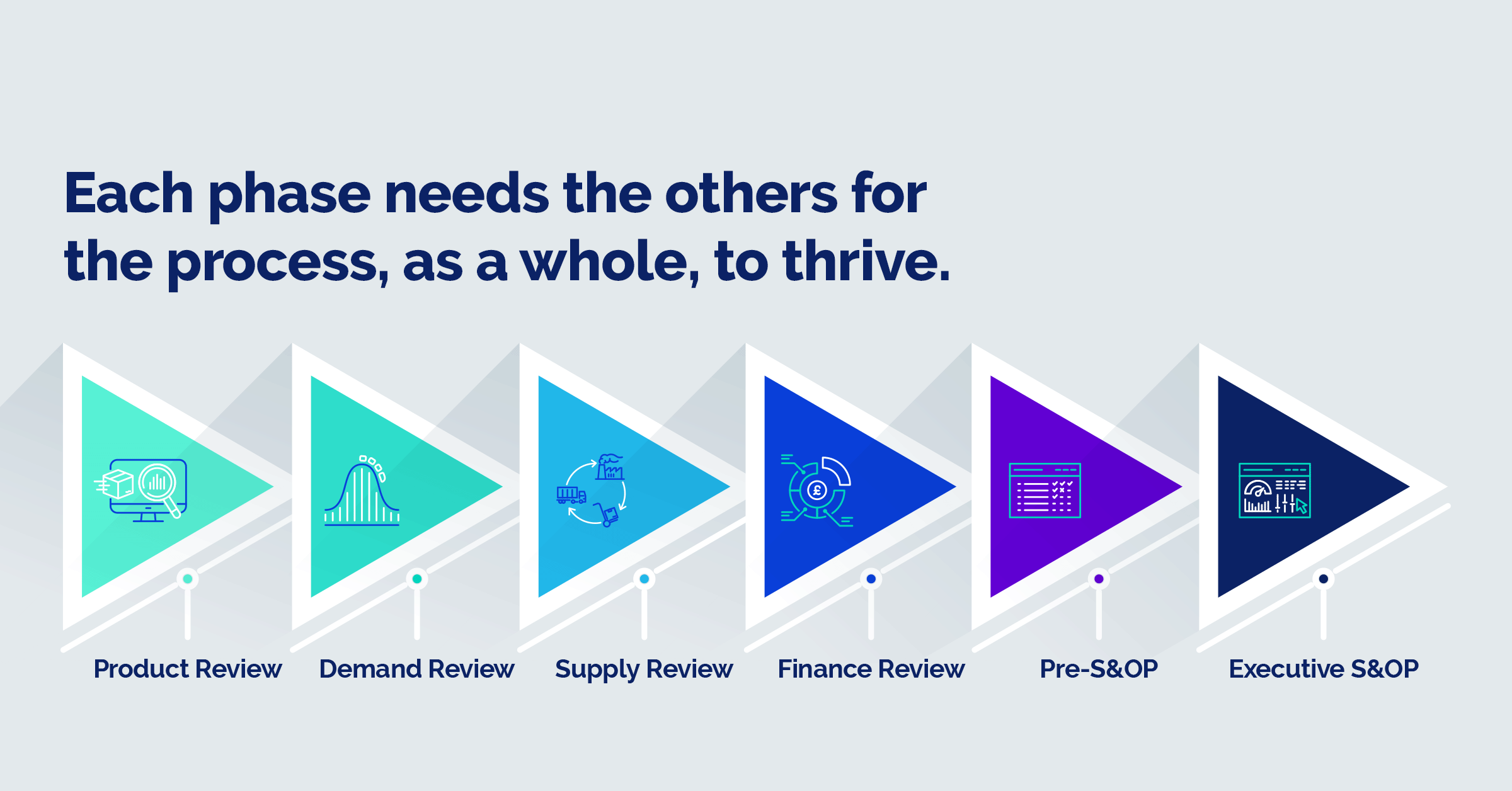
The six phases of S&OP
S&OP is a monthly integrated business management process that empowers leadership to focus on key drivers.

A new era for S&OP
An effective sales and operations planning (S&OP) function is essential to thrive in today’s operating environment. Read more…

5 areas HR leaders should focus on in the coming year
HR is well positioned to bring data-driven insights to talent decisions, read our blog to find out more

The role of finance shifts during a business disruption
Regular communication is critical in the beginning, both about the “knowns” and “unknowns”; this will ease misgivings, decrease distraction, and keep people motivated.

Global supply chain disruptions and the workforce impact
Ongoing supply chain disruptions are pushing HR leaders to consider a variety of scenarios, including talent plans. Read more

Continuous planning enables a more agile organisation
During crisis conditions, finance must accelerate budgeting and forecasting work, providing continually updated business information that can then be incorporated into forecasts

The latest talent trends – focus areas for HR (part 3)
Organisations need to focus on team dynamics and wellbeing, sustainability as well as connecting to the organisation’s purpose. Read more

The focus of finance changes during a crisis in resilient organisations: (checklist)
There are several areas where finance plays a crucial role during (& after) a business disruption such as cash flow, risk management, financial obligations as well as strategy and planning

The three phases of a crisis for organisations
Finance will have to prioritise and communicate during all three stages of a business disruption. Read more…

The latest talent trends – focus areas for HR – Part 2
Agile organisations require increased adaptability to support employee mobility and the resulting shift in the hiring process. Read more

The latest talent trends – focus areas for HR – Part 1
Flexible or remote working and a more fluid approach to working groups are becoming the latest HR trends, read more

The role of the CFO has changed in the past few years
The CFO must respond quickly and strategically to any crisis, that’s in addition to the changing regulatory and compliance landscape

How analytics will drive buy-in for HR transformation
As the organisation of the future takes shape, HR will need analytics to support key business decisions and buy in for a transformation. Read more…

Budgeting step 5: Senior leadership approves the annual budget
It is the same story repeated over and over – Finance gets stuck performing manual checks to make sure sums and balances tally. Annual budgeting using a Connected Planning solution...

Why you should consider sending your team on software training:
You’ve invested in Anaplan, what next? Anaplan is an intuitive and user-friendly platform, capable of transforming how your organisation operates. To unlock its full potential, you want your team to...

Budgeting step 4: Bottom-up budgets are presented back to senior leadership
In step 4, the finance team need to present the budget to senior leadership for approval. For a best practice approach, read more.

Budgeting step 3: Finance prepares business unit-level budgets from the bottom up
This blog compares step 3 of a conventional budgeting process to budgeting with a connected planning platform. Read more…

Budgeting step 2: Circulate top-down budget targets among business unit leaders
Comparing step 2 of a conventional budgeting process with spreadsheets or legacy systems to budgeting with a connected planning platform.

Budgeting step 1: align business unit/departmental budgets to strategic objectives
This blog shares the first step of budgeting using a connected planning platform. setting the high level targets. Read more…

Mastering the basics of budgeting
A better way to manage the annual budgeting process for everyone, one that gets past the inherent limits of spreadsheets, and the result of which is a high-impact financial plan...

Improving end-to-end transparency and reducing supply chain risk management
Creating a comprehensive view of the supply chain, mapping and identifying all relationships will give an organisation a view of potential vulnerabilities. Read our final blog in Supply Chain Resilience...

Supply chain challenges: changing consumer trends
To meet customer expectations and win in the market, retailers must anticipate and adjust to rapid shifts in demand, supply, as well as changing customer sentiment and expectations. Read our...

Supply chain disruptions and risks
An organisation’s supply chain can be a source of vulnerability or resilience, depending on its effectiveness in monitoring the various risks. Read our first blog in Supply Chain Resiliance series...

Putting advanced analytics front and centre of the strategy process
Expansion is an expensive business, so using the company’s data and connecting it to make more informed, accurate decisions will help ensure that they don’t burn through valuable capital. Read...

How to manage hypergrowth businesses efficiently
By focusing on scaling the people, supporting an innovation culture and decentralised decision-making, fintech businesses can manage hypergrowth curve efficiently. Read our latest blog in hypergrowth series to find out...

The challenges that hypergrowth businesses face: part 2
Eliminating manual processes, such as spreadsheet-based forecasting seems an obvious area to consider when looking for productivity gains in organisations striving for hypergowth. Read our latest blog to find out...

The challenges that hypergrowth businesses face: Part 1
Typically, hypergrowth fintech organisations have huge cash burn rates and can easily go out of business if they fail to manage their operating expenses. Read our latest blog to find...

The characteristics of a hypergrowth organisation
Hypergrowth can be achieved in a couple of different ways, find out the characteristics that create successful hypergrowth organisations.

Fintech trends in 2021: hypergrowth is the new normal
If last year was about survival, 2021 is about convenience, inclusion and sustainability fuelling the further adoption of financial technologies, both in the coming year and beyond.

Hypergrowth & unicorn status. What is it and why do so many aspire to it?
To achieve unicorn status, to be a startup company with a valuation of over $1 billion, is one of the most desired phases of any fintech company’s existence.

Nine risks and factors to consider when upgrading legacy IT systems
Legacy systems can hold back innovation, resulting in significant losses. Outdated software is less efficient, which has a negative impact on employee productivity.

The five risks of using spreadsheets for scenario planning and forecasting
Five risks of using spreadsheets and why they can no longer support business requirements. Discover why legacy systems should be upgraded.

The three building blocks for resilient organisations: part 2
Yesterday’s data architecture cannot meet today’s need for speed, flexibility, and innovation. Find out how to leverage external data.

The three building blocks for resilient organisations: part 1
What will the new normal look like for organisations? Remote collaboration and technology, what do they have in common? Find out how to leverage hybrid working.

Seven initiatives for resilient organisations entering recovery and thrive phase
These cannot be ignored when growing a business during crisis including uncovering value, decision making and workforce adaptability.

Five tactics resilient organisations take to respond to a crisis
Scenario planning and effective forecasting is just one of the five response tactics businesses must take during a crisis.

What is organisational resilience and why is it important?
A typical crisis unfolds across three phases: respond, recover and thrive. The challenge lies in being able to nimbly consider all three phases concurrently and allocate resources accordingly.

Anaplan PlanIQ with Amazon Forecast is here!
Anaplan PlanIQ with Amazon Forecast, can help teams across finance, supply chain, sales and human resources to make highly accurate decisions.

A new focus on customer service
The way in which businesses support, sell and communicate with their customers has changed, and heightened expectations from customers who now expect nothing less than exceptional service.

The role of connected planning post-COVID for CPG companies
Planning is too often siloed in individual lines of business. The key is that they are done as part of a cohesive, integrated, and enterprise-wide whole.

Seven areas to consider in a post-COVID world for CPG companies: part 2
Despite all the negative impacts COVID created, it’s provided opportunities for transformation too – digital differentiation, proactive customer management and global operating models.

Seven areas to consider in a post-COVID world for CPG companies: part 1
Post-COVID CPGs need to adopt a new model, that looks quite different from the old model, by continuing to leverage scale advantages, changes in marketing, supply chain and back office.

Four consumer trends that the CPG industry cannot ignore in a post-COVID world
To emerge stronger from the pandemic CPGs must look beyond the immediate challenges and into the next normal, such as contactless and subscription shopping.

3 changes in consumer behaviour and how it affects the CPG industry in a post-COVID world
COVID has caused major upheaval and consumer behaviour shifts. Three trends have emerged, including nesting-at-home and unexpected fluctuations in demand.

It’s a new day for the CPG industry
Companies with greater enterprise agility can be positioned to respond to heightened uncertainty, including both supply chain responsiveness and consumer-facing experiences.


