Basel III Endgame and the Capital Planning Blind Spot: How regulatory change exposes the gap between capital compliance and capital strategy

Share
Related Posts




Bedford Consulting | Banking Insight Series
Somewhere in a bank’s finance department, a team is building a capital adequacy model. Down the corridor, a separate team is running stress test scenarios. On another floor, the business strategy teams are mapping out balance sheet growth targets for the next sixty months. Each team is working diligently. Each is producing rigorous analysis. And almost certainly, none of them is using the same baselines, data or assumptions as the others.
That disconnect has always been uncomfortable. But in 2026, with regulatory capital frameworks shifting on both sides of the Atlantic simultaneously, it has become something closer to dangerous.
A regulatory landscape in motion
The Basel III Endgame has been a slow-moving story for the better part of a decade. But in the past twelve months, the pace has picked up considerably, and the direction of travel has become clearer.
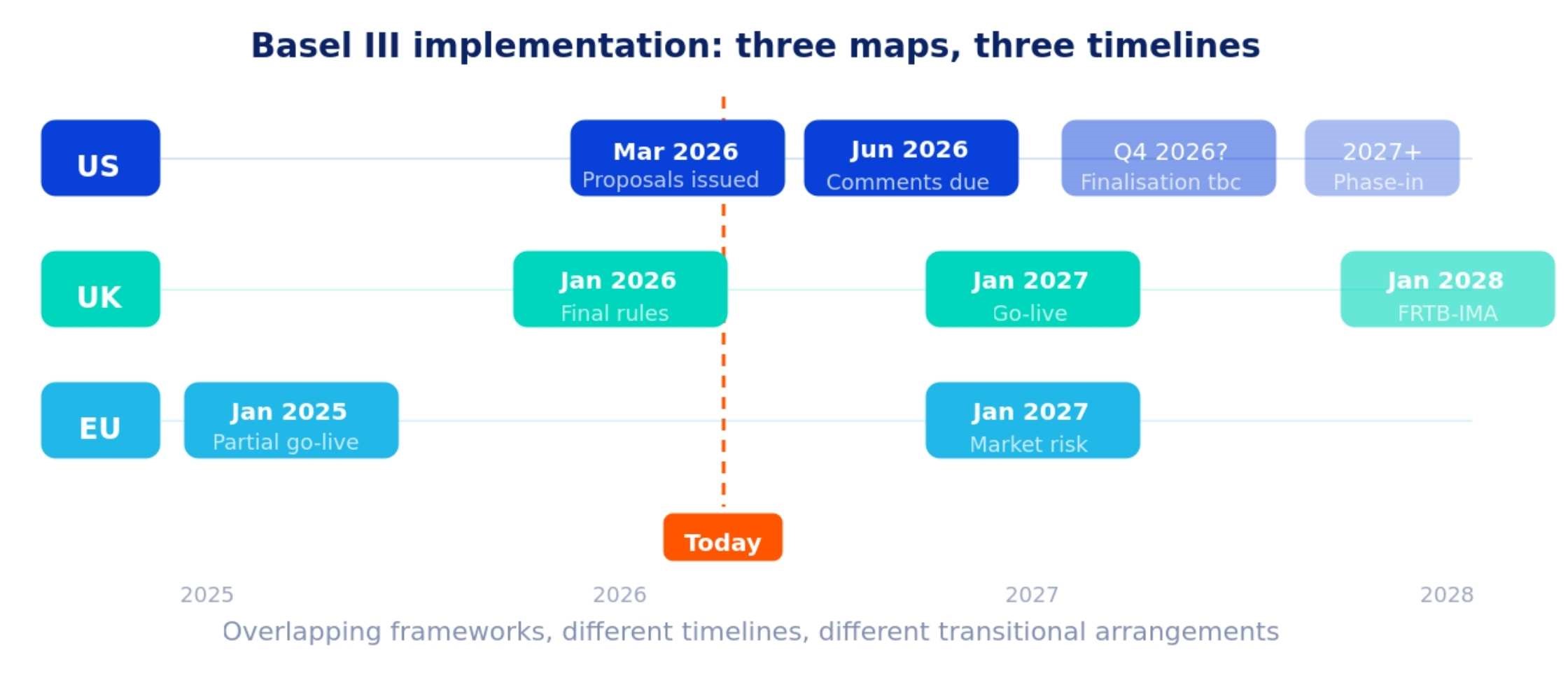
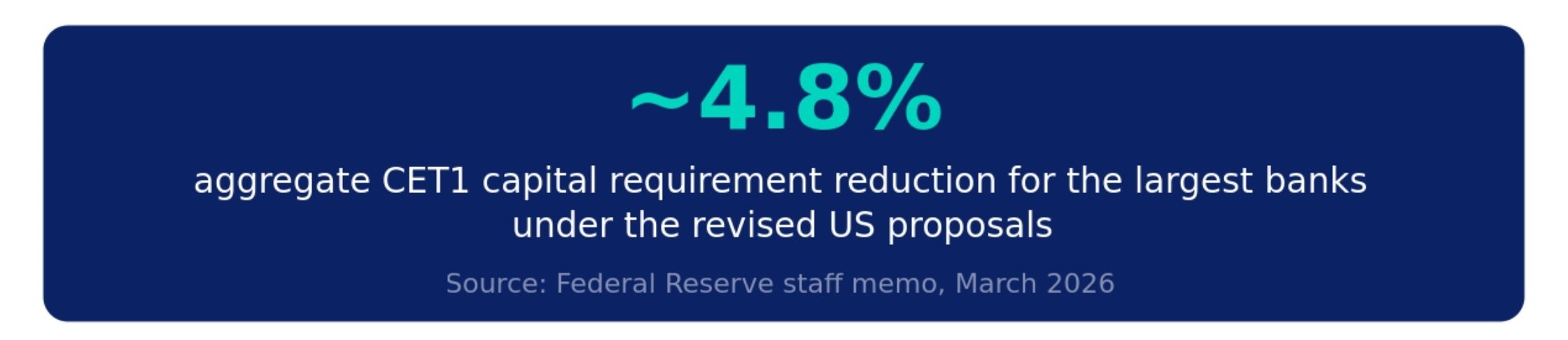
In the United States, the Federal Reserve, OCC, and FDIC issued three coordinated proposals in March 2026 that would comprehensively overhaul the bank capital framework. The revised proposals represent a significant directional shift from the 2023 originals, which had called for substantially increased capital requirements. The new package is designed to be broadly capital-neutral, with regulators evaluating cumulative impact across all four pillars of the capital framework: stress testing, the supplementary leverage ratio, the Basel III standards, and the G-SIB surcharge. Comments are due by June 2026.
In the UK, the PRA published its final Basel 3.1 rules in January 2026, confirming an implementation date of 1 January 2027. The delay from the original timeline was driven by uncertainty around U.S. implementation, but the PRA has now locked in its approach across credit risk, the output floor, operational risk, and Pillar 2 adjustments. The market risk internal model approach has been pushed back a further year to January 2028, but the rest of the package proceeds on schedule.
For European banks, implementation has been rolling since January 2025, with the market risk elements delayed until 2027. The net effect is a period where major banking jurisdictions are implementing overlapping but not identical versions of the same framework, on different timelines, with different transitional arrangements.
For a bank CFO, this is a bit like being asked to navigate by three maps at once, each drawn to a slightly different scale.
The compliance trap
The natural instinct when facing regulatory change of this scale is to treat it as a compliance exercise. Assemble a project team, build the new calculations, file the returns on time, and move on.
That instinct is understandable, and it’s also dangerously incomplete.
The Basel III Endgame doesn’t just change the arithmetic of capital adequacy. It changes the economics of the business. New risk-weighting methodologies alter the relative capital cost of different lending activities. The output floor constrains how much benefit a bank can extract from internal models. Changes to the G-SIB surcharge calculation affect the largest institutions’ cost of doing business at a structural level. Operational risk capital, now calculated through a standardised formula incorporating historical loss data, creates a direct link between past performance and future capital requirements.
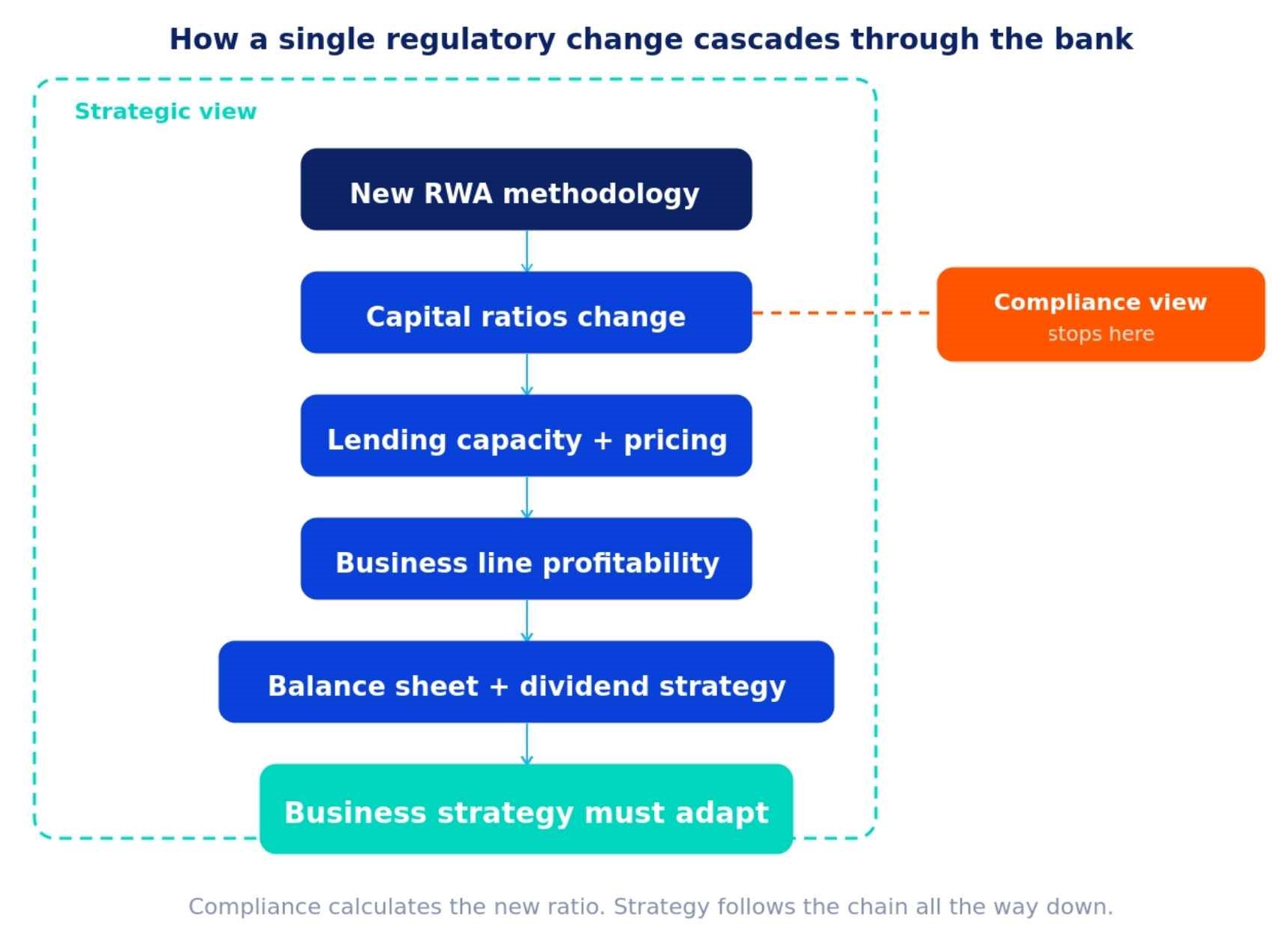
Each of these changes, on its own, is manageable. But taken together, they cascade through the bank in ways that a compliance-only lens will never capture. The capital cost of a mortgage portfolio changes. The relative profitability of different business lines shifts. The optimal size and shape of the balance sheet looks different from how it looked twelve months ago.
And here is where the blind spot emerges. Most banks will calculate the new ratios correctly. Far fewer will connect those calculations to business strategy in a way that allows the CFO to answer the question that actually matters: given the new capital regime, what should we do differently?
Where the assumptions collide
In our first article in this series, we described the problem of planning functions operating in silos, each producing defensible analysis that doesn’t quite fit with what the team next door is building. Capital planning under Basel III Endgame is where this problem becomes most acutely dangerous.
Consider what a bank needs to model simultaneously. The risk team needs to calculate new risk-weighted assets under the revised standardised approaches. The finance team needs to understand what those RWA changes mean for capital ratios, and therefore for the bank’s capacity to lend, pay dividends, and invest. Treasury needs to model the liquidity implications of any balance sheet adjustments. The business strategy team needs to know which products and segments remain attractive under the new capital economics. And the stress testing team needs to run all of this through severely adverse scenarios that have their own set of regulatory requirements.
If these workstreams run on separate models with separate assumptions, the bank will produce a set of answers that are individually correct and collectively incoherent. The risk team’s RWA calculation might assume a static balance sheet. The business strategy team’s growth plan might not reflect the capital drag of the new operational risk formula. The stress testing team’s scenarios might not incorporate the strategic responses that management would actually pursue under stress.
We’ve seen versions of this play out with clients. In one case, we found that operational constraints weren’t feeding into financial scenarios at all, meaning the capital plan assumed resources that the business couldn’t actually deploy. In another, scenario plans existed on paper but had never been designed to be compared side by side, so leadership couldn’t evaluate trade-offs between strategic options in any meaningful way.
These aren’t failures of competence. They’re symptoms of planning architecture that was designed for a simpler regulatory world.
Capital planning as a strategic discipline
There is a different way to approach this. It starts with treating capital planning not as a regulatory return but as the connective tissue between risk, finance, strategy, product and operations.
In a connected planning environment, when the risk team updates its RWA calculations to reflect the new Basel III methodology, the finance team sees the impact on capital ratios in real time. Treasury sees the liquidity implications. The business strategy team sees which lending segments now require more capital and which have become relatively cheaper. And critically, leadership can compare scenarios: what happens if we grow the mortgage book by 10%? What if we exit a capital-intensive segment instead? What does the stress test look like under each path?
This kind of connected modelling turns a compliance exercise into a strategic conversation. The CFO stops being the person who reports on capital adequacy and becomes the person who shapes the bank’s response to a changing regulatory environment.
PwC’s recent analysis of banking trends underlines the point. Analysts and investors are no longer satisfied with banks simply meeting their capital requirements. They want to see evidence that management can articulate a credible capital allocation story, one where growth, discipline, and investment choices are coherent, measurable, and resilient. A bank that can model the interplay between Basel III changes and business strategy in a single, governed environment is in a materially stronger position to tell that story convincingly.
The governance question nobody is asking
There’s a dimension to this that often gets overlooked in the rush to build new models: governance.

Basel III Endgame doesn’t just change numbers. It changes relationships between numbers. The output floor creates a new binding constraint that links the standardised and internal model approaches. The operational risk formula ties capital to historical losses in a way that didn’t exist before. The G-SIB surcharge recalibration changes the balance between complexity and cost.
Each of these new relationships requires someone to own the assumption that flows between one model and the next. Someone needs to ensure that “risk-weighted assets” are the same thing in the capital plan as it does in the stress test. Someone needs to track what happens when one team updates an assumption that another team’s model depends on.
At Bedford Consulting, we talk about this as the governance layer between models, and in our experience it’s the layer most banks underinvest in. The individual models are often excellent. The connections between them are often held together by spreadsheets, manual processes, and institutional memory. That’s fragile at the best of times. During a period of significant regulatory change, it becomes actively dangerous.
We’ve found cases where critical capital planning decisions were being informed by models with no clear ownership. We’ve surfaced situations where definitions drifted between teams without anyone noticing. These are the kinds of blind spots that don’t appear in any regulatory filing, but they determine whether a bank’s capital strategy is built on solid foundations or on sand.
What the best-prepared banks are doing
The banks that will navigate this transition most effectively share some common characteristics. They’re not just calculating the new numbers; they’re modelling the strategic implications of different scenarios. They’re connecting capital, risk, and business planning on a shared platform so that trade-offs are visible and decisions can be pressure-tested before they’re committed to. They’re investing in the governance that ensures their models stay aligned as the regulatory framework evolves through its transitional periods.
Anaplan’s architecture is well suited to this challenge because it allows banks to build and connect models across functions without the brittle linkages of spreadsheet-based planning. Finance, risk, treasury, and business planning can operate on shared data and shared assumptions, with real-time visibility into the downstream consequences of any change. That’s a practical advantage when you’re trying to model the cascading impact of a new capital regime across an entire institution.
But as we’ve argued throughout this series, the technology is only part of the picture. The harder work, and the more valuable work, is designing the governance framework that ensures the models remain connected, the assumptions remain transparent, and the decisions they inform are grounded in a single version of the truth. That design work is Bedford’s speciality.
Where this leads
In the final article in this series, we’ll turn to the issue that sits at the heart of both the CFO mandate and the regulatory challenge: forecast confidence. Why do so many bank CFOs present numbers they’re not fully confident in? And what does it take to close that gap?
Bedford Consulting is Anaplan’s longest-standing EMEA Partner of the Year, with deep expertise in financial services planning. To discuss any of the themes in this article, contact our banking team at info@bedfordconsulting.com.
By Ewan Smith, Subject Matter Expert Banking and Finance, Bedford Consulting
Ewan Smith is a Finance and Banking expert at Bedford Consulting, specialising in complex FP&A, balance‑sheet‑led planning, and regulated banking environments. With deep experience supporting financial services organisations, Ewan works closely with clients across capital planning, stress testing, scenario modelling, and end‑to‑end financial planning use cases.
Operating frequently in Programme Director and senior client‑facing roles, Ewan leads large‑scale, multi‑workstream engagements, bringing together strong governance, stakeholder alignment, and delivery discipline. He combines deep Anaplan and connected planning expertise with a business‑first mindset, ensuring solutions are designed to support confident decision‑making, long‑term adoption, and measurable value beyond go‑live.