The planning gap no one talks about: why mid-market businesses are more exposed than they think

Share
Related Posts



Bedford Consulting | The confidence gap series
A FTSE 100 retailer changes its European pricing strategy on a Tuesday. By Wednesday morning, the models have been updated, the margin impact is quantified across four scenarios, and the executive committee is making decisions with current data. A five-person e-commerce business does something similar over a coffee and a spreadsheet. The founder adjusts prices, watches what happens, and pivots by Friday.
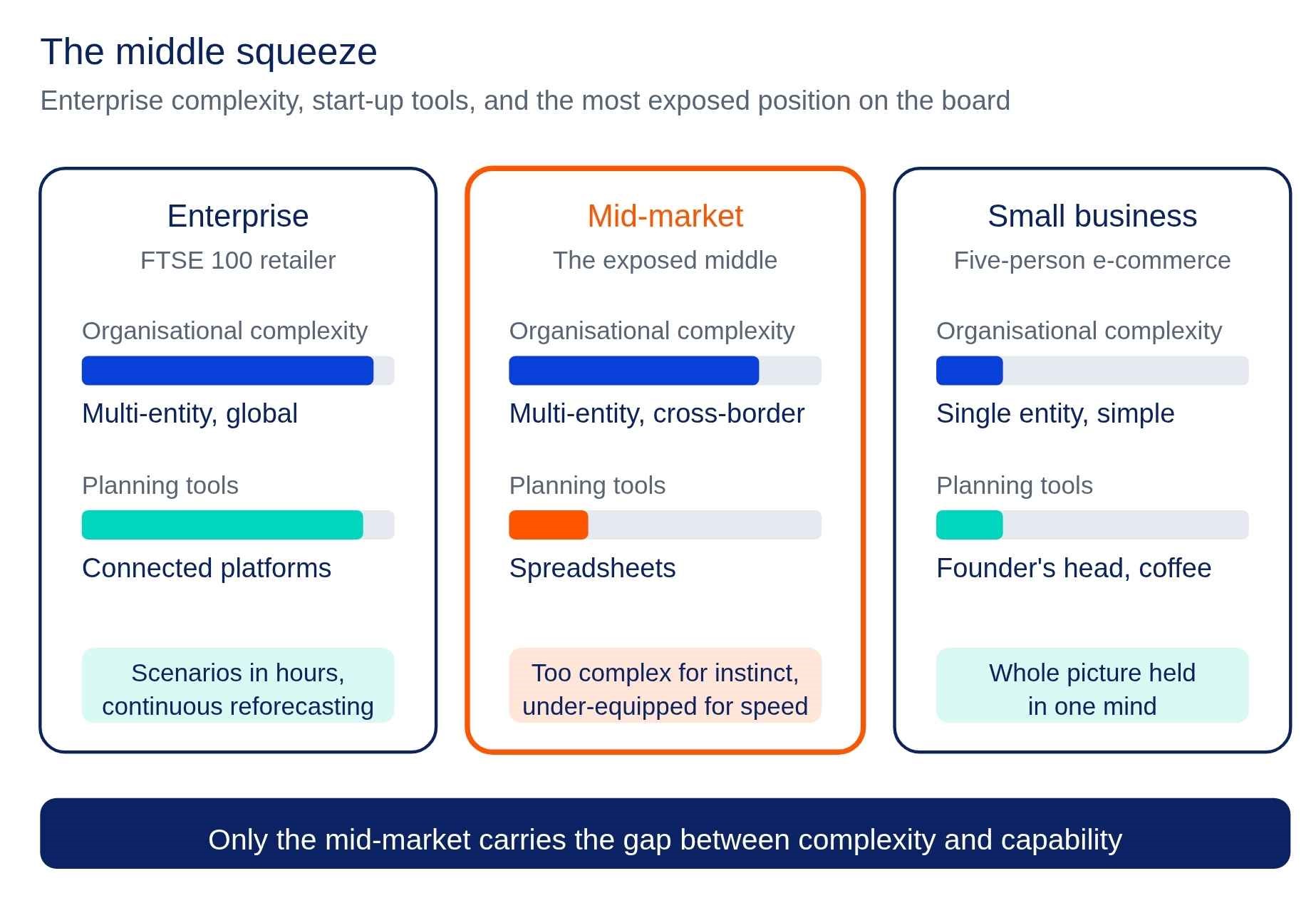
Now consider the mid-market manufacturer sitting between them. Complex enough to have multi-entity operations, cross-border exposure, and a finance team of fifteen. But still running planning on the same spreadsheets they’ve used for the past decade. They have the complexity of the enterprise and the tools of the start-up. And in a volatile market, that’s the most exposed position on the board.
The middle squeeze
The ceiling rarely announces itself. It shows up as a pattern. You ask for three scenarios by Thursday and get one by Friday. You request a sensitivity analysis on input costs and learn it means rebuilding the model from scratch. You want to understand the cash impact of a pricing change across two divisions and discover the data lives in separate files that don’t talk to each other.
None of this reflects a lack of capability in your team. What it reflects is a tool that wasn’t designed for the questions a modern CFO needs to ask. When models grow large enough to take 30 minutes to recalculate per run, scenario planning stops being a strategic exercise and becomes a rationing decision. Which scenarios are worth the time? Which questions do we simply not ask because the effort of modelling the answer outweighs the deadline?
That rationing is invisible to the board. But it shapes every forecast you present.
The risk you might not see
Enterprise businesses have spent years investing in connected planning platforms. They can model scenarios in hours, reforecast continuously, and connect financial plans to operational execution in near real-time. They don’t always do it well, but they have the infrastructure to do it.
Small businesses don’t need that infrastructure. Their planning is fast because their organisations are simple. The founder can hold the whole picture in their head. Decisions happen in conversations, not consolidation cycles.
Mid-market businesses have neither advantage. They’re too complex for instinct and too under-equipped for speed. Their planning processes carry enterprise-grade complexity through spreadsheet-grade tools. And the gap between what they need and what they can deliver is widening, because the environment they’re planning in refuses to sit still.
Gartner’s 2026 CFO Agenda survey found that cost optimisation dominates CFO priorities, while confidence in technology and talent-driven initiatives is actually declining. That’s a revealing combination. Mid-market CFOs know they need to move faster, but they’re losing faith in their ability to make the investments that would let them do so. The squeeze gets tighter.
Where the gap shows up
The planning gap doesn’t announce itself with a single catastrophic failure. It shows up in the accumulation of small, costly delays.
A missed hedging window because the FX exposure analysis took too long to produce. A margin erosion that was visible in the operational data weeks before it appeared in the financial forecast, but nobody connected the two. A pricing decision deferred to next quarter because the scenario analysis couldn’t be turned around in time. A board meeting where the CFO spent more time explaining the assumptions behind the number than discussing what to do about it.
Each of these moments has a price. Individually, they’re absorbed as the cost of doing business. Collectively, they represent a structural competitive disadvantage that compounds over time. The enterprise competitor who can reforecast in hours is making the same decisions faster, with more confidence, and capturing the margin that the mid-market business is still modelling.
The disconnection problem
One of the least discussed aspects of the planning gap is the disconnection between financial plans and the operational reality they’re supposed to reflect.
Consider a mid-market financial services business planning for growth. The revenue forecast looks achievable on paper. But the sales pipeline hasn’t been connected to the hiring plan. The underwriting team is planning for increased volume, but the sales team doesn’t have the throughput to deliver it. The finance model says one thing. The operational capacity says another. And nobody has joined the two together because the planning tools don’t allow it.
This disconnection is common across sectors. Supply chain plans that don’t reflect commercial commitments. Workforce plans that don’t align with revenue assumptions. Capital expenditure forecasts built independently of the operating model they’re supposed to support. Each function plans in its own silo, with its own spreadsheet, on its own timeline. The CFO is left to stitch it together manually, often discovering the contradictions too late to act on them.
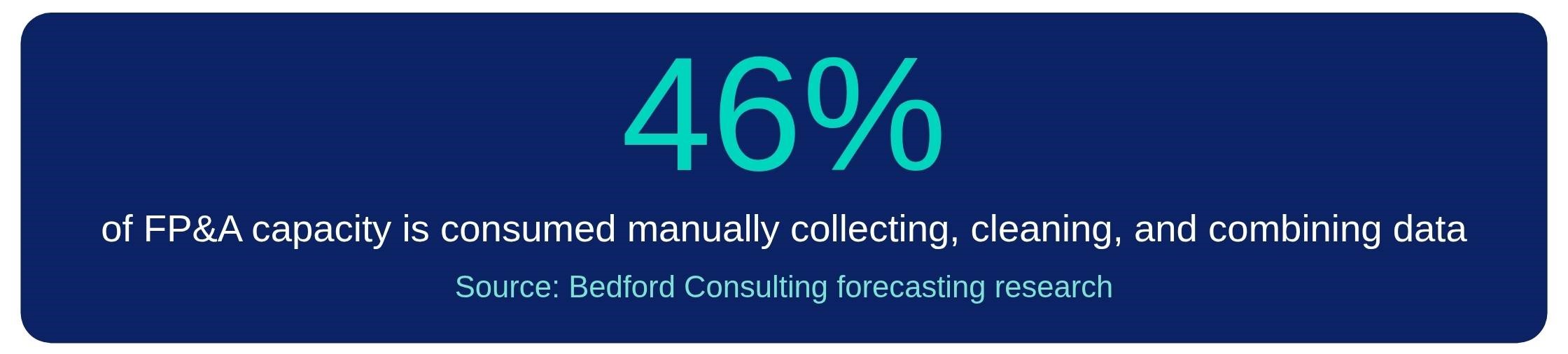
Bedford’s own forecasting research found that FP&A teams typically spend 46% of their time manually collecting, combining, cleaning, and manipulating data. That’s nearly half of your planning function’s capacity consumed before anyone starts to think. In a mid-market business where the finance team is already lean, that ratio is the planning gap in a single number.
What today’s landscape does to an exposed mid-market business
The past two years have been a stress test for planning capability, and the mid-market has felt it acutely.
Interest rate volatility has complicated every debt servicing assumption and investment case. Trade policy shifts and tariff uncertainty have rewritten cost models with little warning. Sterling’s instability against the dollar and euro has created FX exposure that many mid-market businesses lack the tools to model in real time. The tariffs that rocked businesses in 2025 are still in place, and CFOs are being forced to direct their attention to areas they can influence rather than events beyond their control. That’s sound advice, but acting on it requires the ability to model those areas quickly. Without connected planning, even the act of focusing on what you can control becomes a slow, manual exercise.
A recent CFO survey found that nearly 50% of mid-market CFOs identified a lack of system integration as their biggest challenge. That finding puts a number on what most finance leaders already feel: the tools aren’t keeping pace with the questions.
What finally triggers the change
Most mid-market businesses don’t address the planning gap proactively. The trigger is almost always a painful miss. A margin shock that nobody saw coming because the data wasn’t connected. A cash flow crisis that could have been anticipated with faster reforecasting. A board challenge that exposed the fragility of the assumptions underneath the number.
Sometimes the trigger is competitive. A smaller rival moves faster on a pricing decision. A larger competitor enters your market with a planning infrastructure that lets them undercut and adapt simultaneously. The mid-market business finds itself outmanoeuvred from both directions, and the planning gap is the reason.
Research from Abacum found that organisations reforecasting quarterly see 19% higher EBITDA margins than those relying on annual budgets. That’s not a marginal difference. For a mid-market business operating on tight margins in a volatile environment, the gap between quarterly and annual reforecasting can be the difference between capturing an opportunity and reading about it after the fact.
The question isn’t whether the planning gap exists. If you’ve read the first two articles in this series, you’ll recognise the symptoms: the forecast that’s outdated before it’s presented, the Excel model that can’t keep pace, the reforecast cycle that takes weeks instead of hours. The question is whether you address it before the next shock forces you to.
Seeing what others can’t
The confidence gap we’ve explored across this series has three dimensions. The structural lag that makes forecasts unreliable before they’re finished. The tool ceiling that prevents your team from working at the speed the business demands. And the planning gap that leaves mid-market businesses more exposed to volatility than their complexity warrants.

Each dimension compounds the others. Slow forecasts built on fragile spreadsheets, disconnected from operational reality, in a market that punishes delayed decisions. The cumulative effect is a planning function that works hard but can’t deliver the confidence your board needs to act decisively.
Closing the gap starts with understanding where you stand. In our next piece, we’ll share a practical diagnostic framework that helps CFOs assess their planning maturity and identify the specific areas where speed, visibility, and confidence can be built. Because the businesses that will navigate the next two years most successfully won’t be the ones with the best forecasts. They’ll be the ones who can see what others can’t.
What to read and do next
This is the final article in our confidence gap series. If the patterns we’ve described across these three pieces feel familiar, the next step is to measure the gap for yourself.
The Confidence Grader scores your planning function across five dimensions in under three minutes — and shows you exactly where speed, visibility, and confidence can be built. Because the businesses that navigate the next two years most successfully won’t be the ones with the best forecasts. They’ll be the ones who can see what others can’t. Take the Confidence Grader
Mikhail Kravtsov is a Professional Services Consultant at Bedford Consulting, based in Germany, supporting customers across planning and implementation initiatives. He works closely with clients to design and deliver structured, high‑quality solutions, with a strong focus on clarity, consistency, and usability. Mikhail plays an active role in preparing customer workshops and refining materials, ensuring outputs are aligned to Bedford standards and support confident decision‑making