From pumps to platforms: My unlikely journey into the world of Supply Chain

Share
Related Posts




Greetings, fellow supply chain enthusiasts!
Before we dive into the nitty-gritty details of supply chain management, let me introduce myself (only for those who are new to the organisation). My name is Nishiket Sinha and as one of the designated supply chain experts here, I take the lead in many supply chain implementations and consulting. I also happen to moonlight as an Anaplan consultant, which means I have the power to model complete supply chain solutions or any mathematical model at the snap of my fingers.
Now, I may not have an extensive list of supply chain or Finance certifications to flaunt, but I have got an MBA degree in lean operations and systems. Most of my expertise comes from getting down and dirty in the trenches of inventory management and navigating through various supply chain implementations. Sure, I have cracked open a few textbooks in my time and I still rely on them, but let’s be real – practical field experience is where the real magic happens.
So, buckle up because we’re about to embark on a wild ride through the intricate world of supply chain, where warehouse management, logistics, and procurement are just the tip of the iceberg. In this series of articles, I’ll be sharing some of the juicy details on supply chain challenges I have tackled for customers using cutting-edge network design and analytics. And no, I won’t be holding back on the math – you’re getting the full supply chain nerd experience here.
I’ve worked on over 20 implementations (not to brag or anything), but for the sake of brevity, I’ll be focusing on a select few to give you a taste of what’s to come. These articles are aimed at supply chain newbies who are just dipping their toes into the vast ocean of supply chain management. This also means you can expect few fancy jargon and mind-boggling algorithms here.
Oh, and before I forget, I should mention that I am not trying to pass myself off as a supply chain guru. Trust me, you’ll see plenty of instances where I’ve stumbled my way through challenges, only to emerge victorious with a little help from my fellow supply chain experts. So, grab a cup of coffee (or a strong espresso, if you’re feeling daring) and get ready to explore the fascinating world of supply chain management with me. Let’s do this!
A Quick Flashback: Where It All Began
I dove headfirst into the wild world of supply chain back in 2008 after becoming a certified mechanical engineer. Little did I know, my journey was about to take a turn towards the chaotic and unpredictable world of a chemical plant. As a utility maintenance engineer, my days were filled with the thrilling tasks of maintaining and operating machines that churned out all the essential utilities for production. Think chilled water, brine, high pressure steam, purified nitrogen, and of course, everyone’s favourite, electricity.
At that time, the term ‘supply chain’ was as foreign to me. But as I delved deeper into managing a network of procurement and dealing with suppliers for machine parts, coal, and water, I quickly realised that I was knee-deep in the complexities of supply chain management without even knowing it.
Picture this – I had to juggle the maintenance of over 150 pumps, keep 50 refrigeration systems (totalling a mind-boggling 2500 Tons of refrigeration) in tip-top shape, oversee a 4 MW co-generation plant, and manage a workshop filled with jigs and fixtures. And to top it all off, I had a team of dedicated experts by my side, including a general manager, 2 senior Engineers, 4 head fitters, and a motley crew of 25-50 sub-contracted workers.
Back in those glory days, we didn’t have fancy schmancy systems to keep track of our activity. Nope, we relied on good old maintenance books and a Ramco ERP system to juggle inventory and raise purchase orders. Work orders? Don’t even get me started – those were filled out manually in books and handed over to the work crew with crossed fingers and a prayer.
As I navigated through the chaos, I came to realise that I had a curious interest in the world of operations management. So, off I went to pursue a post-graduate course, not just to master the art of supply chain but also to uncover the mysteries of finance lurking in the shadows.
As an engineer, my main concern was ensuring the availability of materials, machines, and labour without a second thought to the financial implications. It wasn’t until I saw first hand the impact of lack of real-time data and optimisation on our operations that I understood the importance of a well-oiled supply chain machine. And so, my journey into the dazzling world of supply chain began, fuelled by chaos, curiosity, and a healthy dose of humour.
From Engineering to Enterprise Planning
In 2015, armed with a shiny new MBA in lean operations and systems, I dove headfirst into the world of IT solution implementation. As is the norm in any tech company, there was a clear divide between the technical and functional teams. Being the rare breed that I am—a hybrid of both mindsets—I naturally found myself drawn to the techno-functional role. I could wrap my head around complex business scenarios and then turn around and whip up some seriously impressive code in SQL, VBA, and R. Sure, I wasn’t a coding prodigy, but I could fashion algorithms and linear programs in Excel/R like nobody’s business.
Then along came Anaplan, the platform that made me feel like a digital superhero. No longer shackled by the limitations of traditional coding languages, I could mould and shape data to my heart’s content. I practically had to wrestle my Head of deliveries to get myself onto the Anaplan team, where I found myself knee-deep in a project with a major conglomerate, putting my newfound skills to the test.
After a few successful implementations, I started to feel like I was hot stuff in the world of Anaplanners. (That is, until I joined Bedford Consulting).
Without boring you with the details of my life let’s skip to the good stuff: the nitty-gritty of how I used my business acumen and Anaplan expertise to streamline our project cycles and deliver top-notch results. Trust me, it’s worth the read.
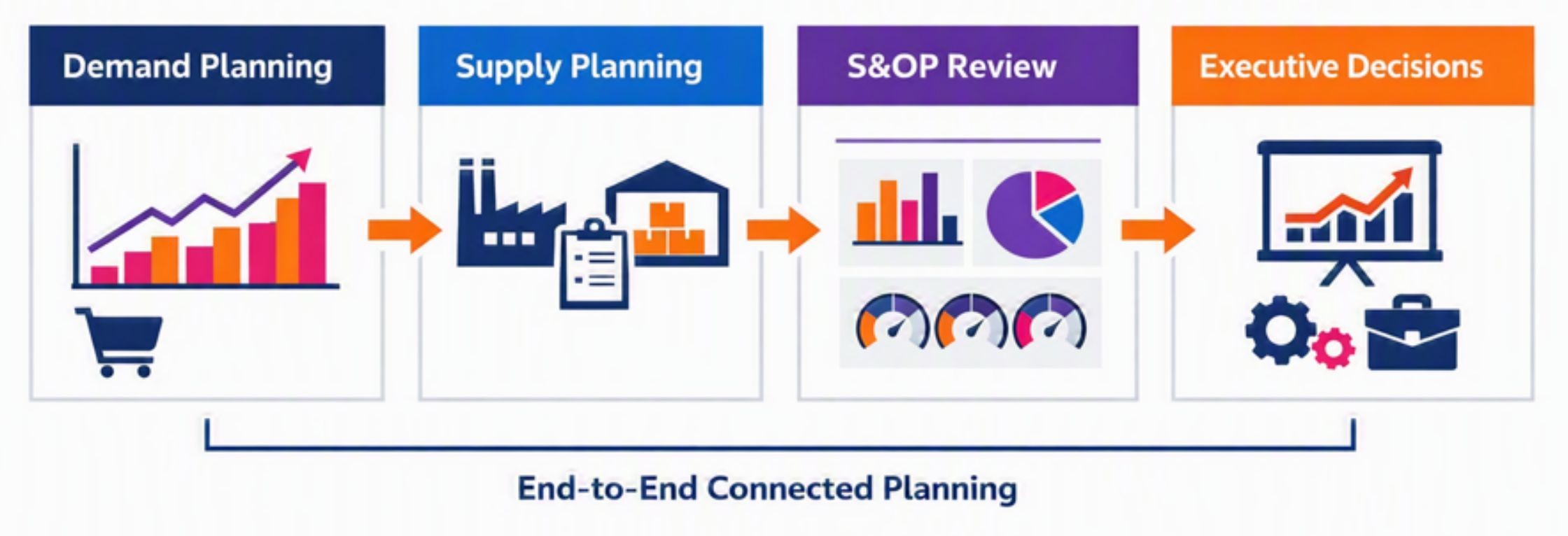
Implementation 1(Year 2022): Industry: Upbeat Pharmaceuticals, spreading joy and pills in over 25 countries!
Use Case Description: The Sales and Operation Planning set up. The Customer was in need of an inventory planning system (a fancy term for a super smart ordering system) that takes into account a bunch of different factors. Think of it like a virtual shopping assistant, but for ordering pills.
Objective:
- Make sure we never run out of stock (because no one likes a sad customer with no meds)
- Base our orders on the Vendor Minimum Annual Quantity (MAQ) requirements (because hey, we want to make our vendors happy too!).
The main challenge was their planning process was all over the place – different teams in different regions, making plans on different spreadsheets. It was like a wild, uncoordinated dance routine. And to top it off, there was no way to track versions or have any sort of a workflow. It was like trying to navigate a maze blindfolded!
So, here are a few of the exciting planning scenarios they threw at us:
- Demand Planning – The easy to medium level.
- We needed to predict demand (in a super scientific way, of course), plan for exceptions, and divide our products into fancy categories.
- We also had to set fancy target goals for forecast accuracy and figure out how to improve them. We like to keep things fun and challenging! This is where you don’t need a system but a team of smart data scientists. Note: this was not the original requirement but turned out to be a challenge later after the implementation
- And let’s not forget about incorporating new products into the mix. It was like welcoming new members into our eager pharmaceutical family.
- Of course, we need a whole management board reporting and workflow dedicated to managing all this demand madness!
Now, let’s move on to the Supply Planning – the medium to high level of excitement.
The customer had an ambitious goal – create the ultimate inventory planning system that considers all the bells and whistles:
- Vendor Minimum Annual Quantity (MAQ) constraints – This also includes system to recommend the best vendors out of the existing lots.
- Product Group constraints – because sometimes pills travel in packs.
- Order Batch Size constraints – because we like to keep our orders in neat little packages. No mess, no fuss!
- Product sell-down period constraints for existing batches – if a product has been lounging on our shelves for too long, it’s time for a retirement party!
- Product sell-down period for recommended orders – because even the newest and shiniest pills need their time to shine!
Our ultimate goal? Zero stockouts or project stockouts wherever impossible to maintain the stocks (ain’t nobody got time for disappointed customers) and ordering that meets our vendors’ MAQ requirements (because happy vendors mean happy business!).
And to wrap it all up, our dream system would take us through the whole S&OP cycle. From pre-S&OP meetings (warming up our planning muscles), to S&OP meetings (where the real magic happens), and post-S&OP meetings (celebrating our genius plans and licking our wounds from any mishaps). And let’s not forget the performance reviews. Because what’s a fancy system without some data analysis and high fives for good performance?
In a world where requirements pile up like laundry and deadlines loom like a storm cloud, implementation can feel like a never-ending saga. Take, for example, the typical scenario of Demand planning and MRP implementations – a process that often takes a mind-boggling 8-9 months. Add in some wacky root distance calculators for BOM explosion, and you’ve got a recipe for disaster. By the way we got only 3-4.5 months to finish them all.
But fear not, for there is hope on the horizon. As we embarked on this epic journey, we quickly realised that our customer was in dire need of a process overhaul. Five days of intense value stream mapping later, we had a roadmap in place and a plan to tackle the chaos head-on.
Our first victory came in the form of shaving off 8-12 days from the Unconstrained demand planning process – a feat worthy of celebration, even if the fruits of our labour were yet to be seen. With data challenges looming large, we rallied the master data management team to our cause, ensuring a smooth sailing ahead.
And then there was the beast known as Statistical forecasting – a creature of complexity and mystery. While other platforms may promise AI/ML-based magic, Anaplan stands apart with its transparent and real-time capabilities. No more waiting for hours on end for results – it’s all at your fingertips, ready to be unleashed.
But the true test comes after the implementation, as we guide the planners through the maze of algorithms to find that elusive sweet spot of accuracy. Like a tournament of champions, various algorithms battle it out to find the most precise forecast for each product and channel combination. And it’s our job to ensure that the planners are armed with the knowledge and tools to make informed decisions. However, we hit a roadblock when the head of planning asked us about the accuracy goal. While the algorithms provide accuracy estimates, they don’t indicate what our target level of error/accuracy should be. Is there a way to establish an accuracy goal based on our product portfolio?
Companies set accuracy targets for various reasons, including:
- Ensuring forecast models meet expected performance standards.
- Determining supply parameters, such as safety stocks and weeks of supply.
However, setting forecast accuracy targets can be challenging. Common approaches include:
- Improving upon previous year’s performance.
- Applying corporate targets uniformly across all items.
Despite these methods, the question remains: where to start?”
In the end, a strategic implementation partner is worth their weight in gold, bringing a Supply chain SME to the table to steer the ship in the right direction. By analysing data and creating custom correlation matrices (Repeatability vs. measure of Variability), we were able to set forecast error goals that were tailored to our client’s unique needs – a feat rarely seen in the world of forecasting. With such a combination of Art and Science planners can improve their forecasting in the subsequent cycles. Furthermore, these matrices are intuitive and easily understood, making them a hit with planners. In simple terms:
- Repeatability is measured by calculating the correlation between year-over-year data. A high correlation indicates high predictability.
- Variability is measured by the coefficient of variation (CV), which is the square of the standard deviation. In Simple term Low CV means the data is highly consistent and high CV means the data is inconsistent and difficult to predict or expect high errors in forecast.
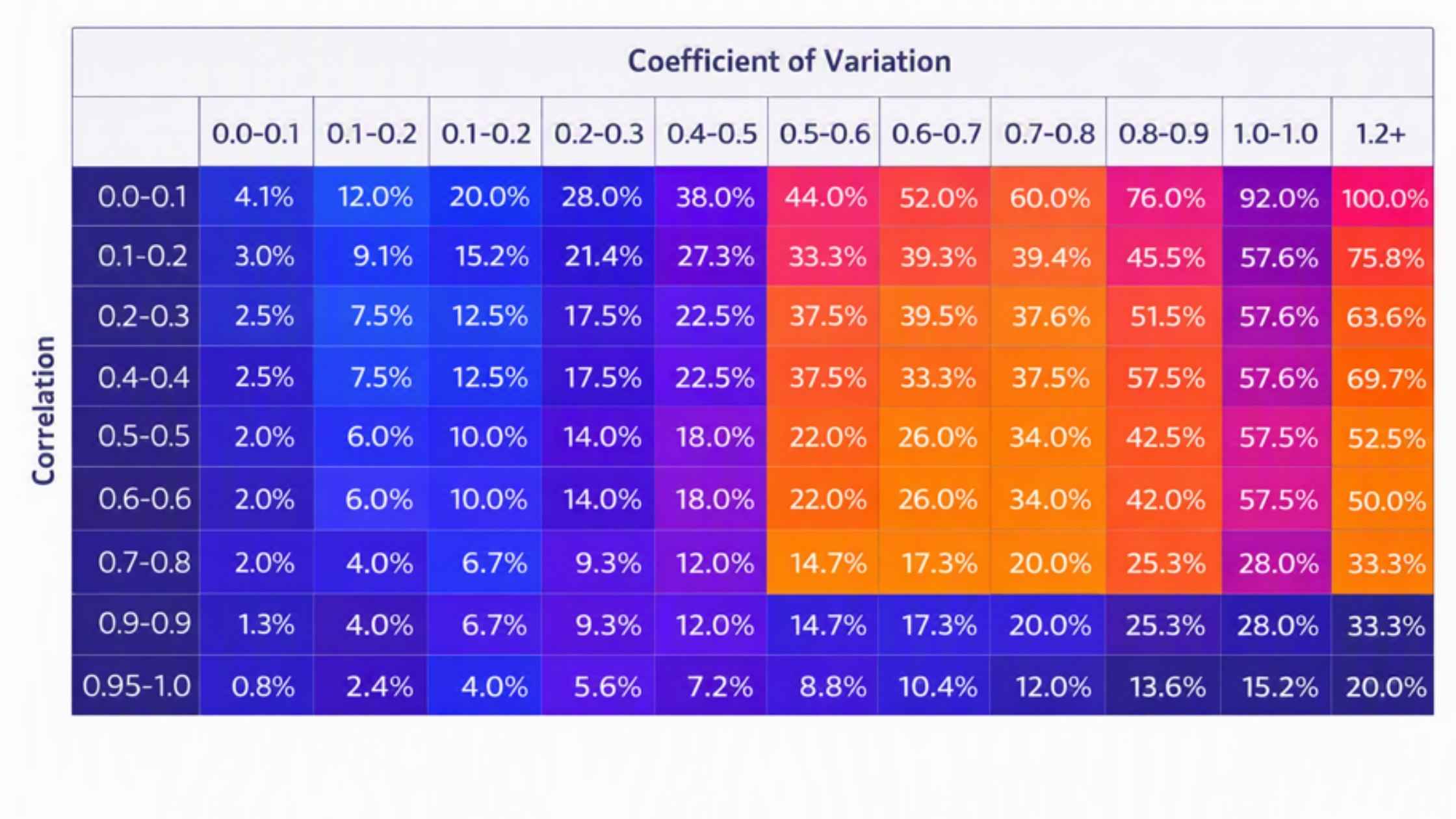
The grid clearly shows that:
- High correlation (close to 1) and low standard deviation indicates very high predictability.
- Predictability decreases as you move right or down in the grid.
In other words, the higher the correlation and the lower the standard deviation, the more predictable the data. Conversely, lower correlation and higher standard deviation indicate lower predictability.
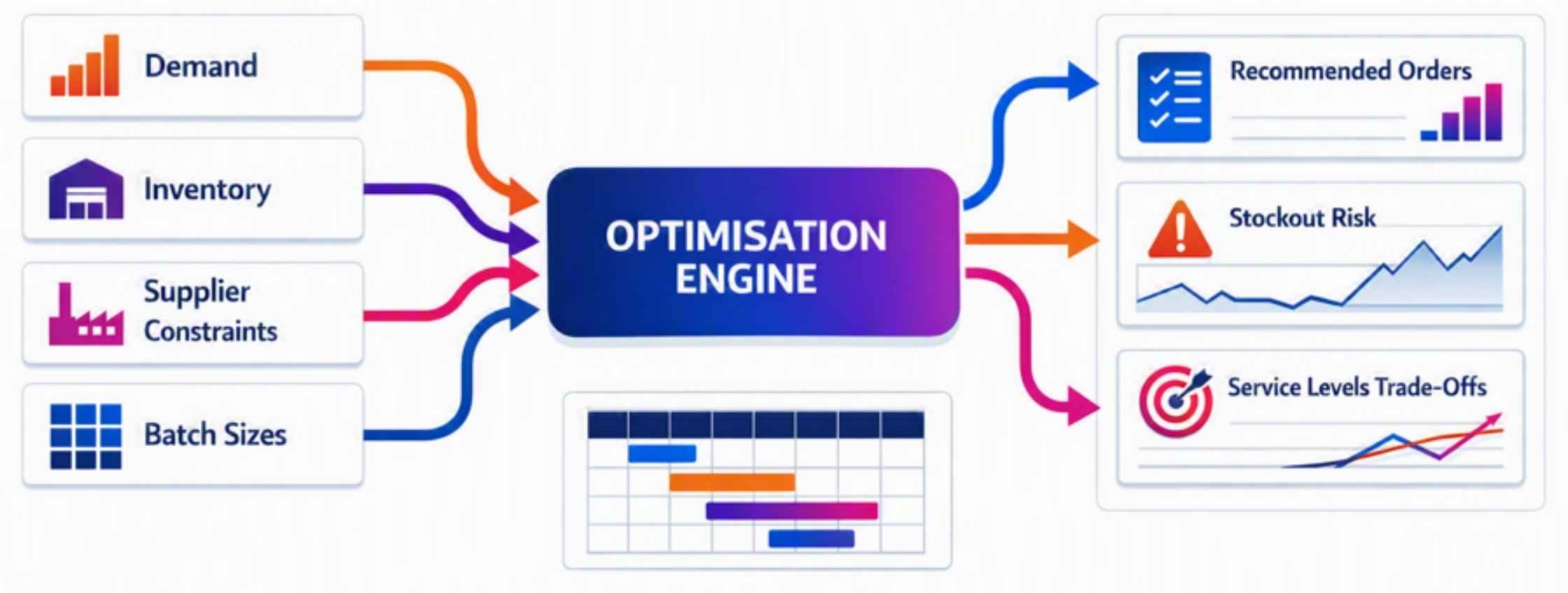
The battle may have been half won, but I was on the brink of a nervous breakdown during my first MRP implementation. Textbooks don’t teach you about the real-world constraints and objectives that come with this kind of math. I have a habit of building small prototypes of solutions in Excel and testing them out, but this time I was trying to create an algorithm to solve all the constraints and objectives at once. After about 20 failed prototypes and a second nervous breakdown, I was ready to throw in the towel and hand the problem over to a team of data scientists. But my ego wouldn’t let me. My older colleague and mentor gave me some great advice: “Nishiket break the problem into smaller chunks” and use goal programming to solve the optimisation problem. It worked like a charm, and we were finally able to crack the code using a mix of mixed integer linear programming and goal programming. The algorithms worked so well that we used them in various other implementations. In future articles, I’ll explain how to use inventory optimisation problems using goal programming and I’ll even publish the mathematical formulations to help other readers and learners.
At the last even though we have been implementing solution which can recommend you the optimised solution one of my major learnings from the implementations and discussions with the on-field planners are:
- There is no concept of a Global Solution i.e. one solution fits all. So, in the design phase always focus on the right supply chain design based on the existing network and product/service portfolio of the customer.
- Supply chain design and optimisation is an art and science.
A science because we can …
- Quantify the impact of different choices.
- Find the optimal trade-offs between cost and service
- Select the best approach given characteristics of the product, supplier, customer, Market etc.
But it is still an art because….
- The future is still uncertain – especially for the longer term.
- Assumptions rarely hold completely
- Models are awesome at making trade-offs but they cannot fully represent reality.
- Data are never completely accurate (regardless of selected precision)
- Situations change over time – sometimes abruptly.
In my coming articles, which I am still thinking about, get ready to explore where the mysterious world of supply chain concepts and actions meets the CFO! Join me on a journey into the depths of business transformation and integrated business planning, where I’ll share my first-hand experiences with implementing a New S&OP. Discover how finance and decision-making go hand-in-hand, and gain an insider’s view of the riveting Review meetings where KPIs and data visualisation reign supreme. Let’s explore the workflows that businesses need to transform their operations with an IBP solution and unlock the secrets of successful business planning along the way.
What to read and do next
Curious what happens next? In the next blog, Why money flow matters in Supply Chain, I explore how financial and material flows are closely connected—and why understanding both is essential for better decision-making.
If your planning process is still reliant on spreadsheets, disconnected teams or unclear assumptions, now is the time to rethink how your supply chain decisions are made. You can reach us at info@bedfordconsulting.com, or follow Bedford Consulting on LinkedIn.
Written by Nishiket Sinha
Nishiket is a Supply Chain and CPG/Retail planning specialist at Bedford Consulting, helping organisations transform demand planning, inventory management, supply planning and commercial decision-making through Connected Planning. With extensive experience delivering Anaplan solutions for complex supply chain and retail environments, Nishiket works with customers to improve visibility, increase agility and create more resilient planning processes across their organisations.