Optimisation in Anaplan: A pragmatic guide to smart modelling

Share
Related Posts



This article reflects my journey in designing and implementing optimisation-driven solutions in Anaplan. Over the years, I have had the opportunity to build models where optimisation wasn’t just a feature, it was the foundation. From inventory planning and production allocation to media/resource distribution, BOM chaining, transportation logistics, store assortment, and scheduling, linear programming has consistently helped me solve complex business problems across industries.
In the world of operations and supply chain management, optimisation often becomes the compass guiding decision-making. Especially in Enterprise Performance Management (EPM) implementations, I’ve found—based on experience rather than data, that in nearly 90% of cases, linear or goal programming is sufficient. Nonlinear optimisation, while powerful, is rarely essential. The key takeaway? Yes, you can implement optimisation in Anaplan—and do it effectively.
The Optimiser Isn’t Always the Hero, Sometimes Simplicity Wins
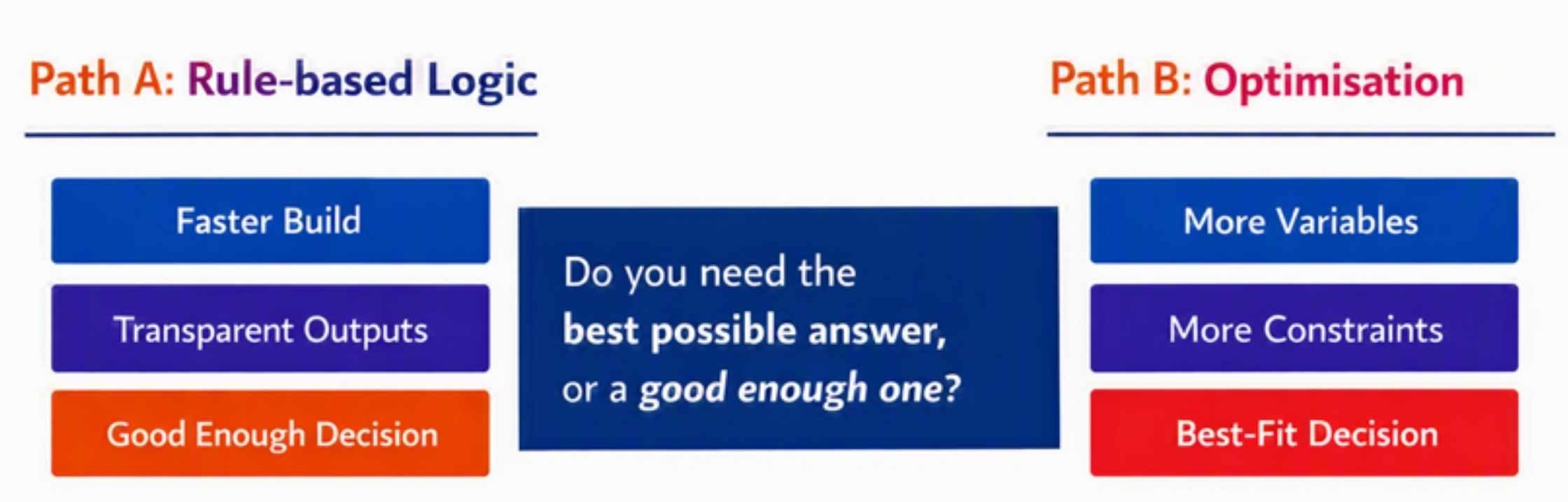
Having access to the Anaplan Optimiser license, the technical skills to formulate problems, and the confidence to build complex models doesn’t automatically mean you should use it. The real question is: Should you?
Before proposing an optimiser-based solution, consider whether simpler methods—like rule-based logic or heuristic approaches, could deliver similar results with less complexity. There’s always a trade-off between quality, time, and effort. In many cases, simple scenario comparison or simulation can produce excellent outcomes without the overhead of full-blown optimisation.
Here are some practical reasons to pause and reflect before diving into optimiser territory:
- Processing Time – Optimisation can be computationally heavy.
- Transparency – Results may feel opaque, bordering on a black box.
- Modelling Complexity – While build time may shrink, problem formulation demands deep domain expertise.
- Maintainability – Future changes can be challenging without the original modelling team.
- Documentation – A well-documented model is essential for sustainability.
If you’ve considered all these points and still feel compelled to use the optimiser, my advice is simple: take a long walk alone and rethink everything.
Not a Warning, Just a Call for Thoughtfulness
If you’re still reading (and not just skimming), let me be clear: I’m not discouraging the use of optimisation. I’m advocating for intentional use—backed by a solid understanding of the problem and a clear cost-benefit analysis.
When Optimisation Truly Adds Value
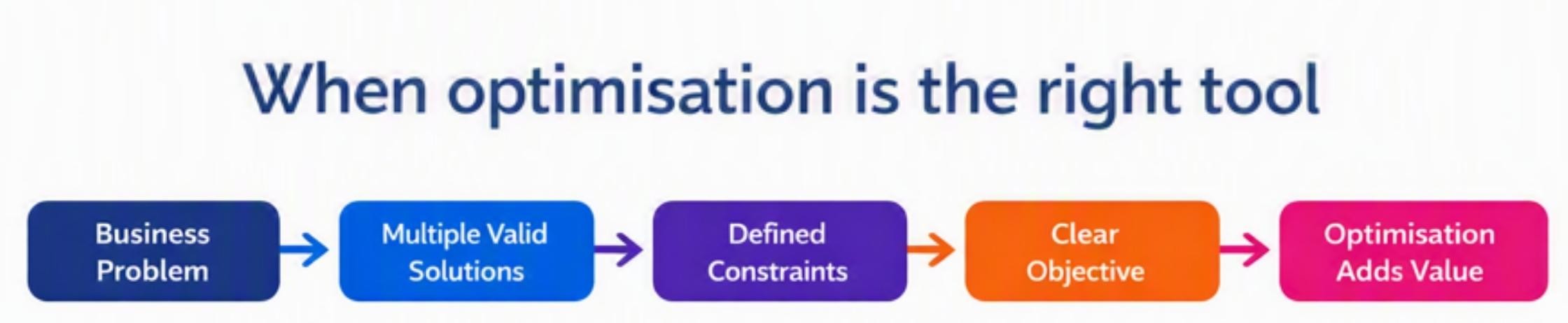
Optimisation shines when multiple valid solutions exist, and the goal is to find the one that delivers the best outcome within defined constraints.
Let’s simplify with an example:
Suppose you need to find values for X and Y such that: X+Y=9
There are countless solutions:
- X = 1, Y = 8
- X = 0, Y = 9
- X = 8.1, Y = 0.9
- X = 4.5, Y = 4.5
All are valid. Now, let’s add constraints:
- X, Y ≥ 0
- X, Y must be integers
This narrows the possibilities.
Let us put this problem into a real-world business case:
- X = Product 1
- Y = Product 2
- Profit from X = £2
- Profit from Y = £3
- Total products to be made = 9
Your goal? To find out how many of X and Y should we produce to maximise profit while meeting production constraints. Maybe you also want to ensure a minimum production level for each product—say, X, Y ≥ 2.
This is where optimisation earns its place. It helps you navigate a sea of possibilities to find the best route forward.
The Blueprint: How to Build Optimisation in Anaplan
Every good optimiser model starts outside Anaplan—on paper. Before you touch the platform, ask yourself:
1. What are my decision variables?
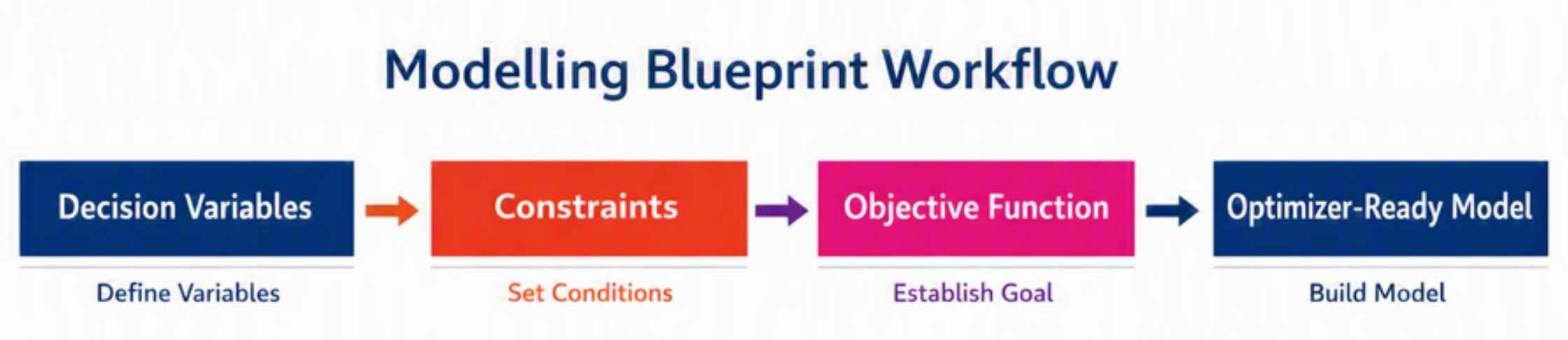
These are the outputs you want Anaplan to calculate (In above example value of X & Y). You may not identify all variables upfront, and sometimes technical variables are needed to make the model feasible. Start with the core problem and build from there.
2. What are my constraints?
These come from business logic and operational rules. Some constraints are technical—like non-negativity or linking variables, but most are defined by the business unit.
3. What’s the objective?
Are you maximising profit? Minimising cost? This defines the heart of your model. Use formal mathematical notation to draft your design, this is where traditional schemas/Design fall short. This helps clarify relationships and dependencies early on.
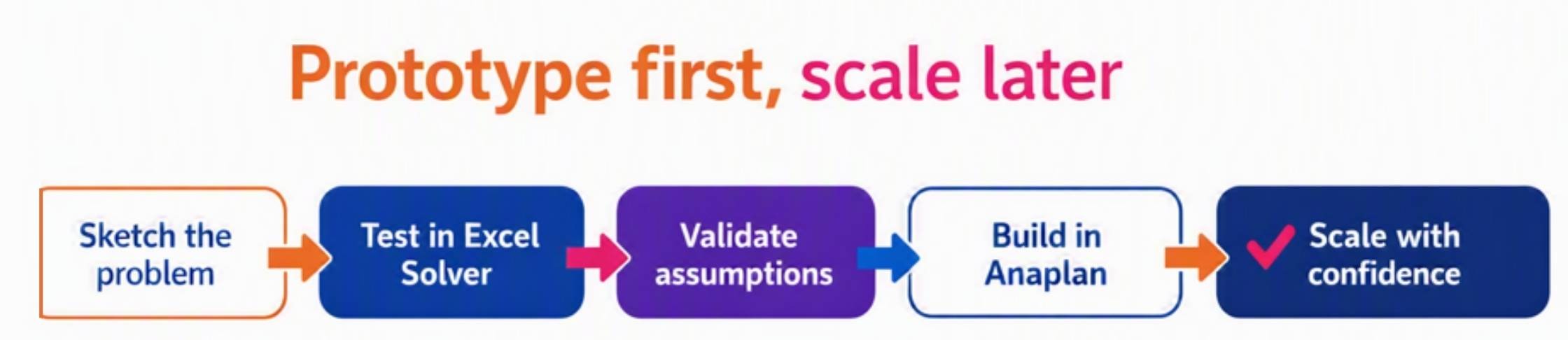
Prototype First, Build Smart and Scale Later
I’m not a data scientist or a mathematician, and my imagination tends to stall after the third dimension (As we live in a 3D world ). So, I always start with small prototypes to test feasibility and identify missing variables or constraints. Excel’s Solver is my go-to for quick modelling, it’s fast, intuitive, and helps validate the theory before scaling in Anaplan.
Whether you prototype externally or build directly in Anaplan, the goal is the same: understand the problem holistically before implementation.
In one of my recent projects, the customer built the optimiser with 45 variables and over 50 constraints. To add to the complexity, they were running 3 optimisers in row doing sequential optimisation. The model took 60 minutes to run and delivered suboptimal results and was almost a night mare for me to reverse engineer those big line of formulation in Anaplan in the absence of correct documentation . So, we went back to the drawing board—guided by first principles—and invested more time in truly understanding the problem. With a clearer perspective, we redesigned the optimiser (one single optimiser solving for three) using just 18 variables and 25 constraints. And if you’re wondering how I arrived at the final solution—and whether it was all born out of sheer imagination—here’s the honest truth: it took over 80 failed attempts, each captured in a different Excel sheet, before I landed on the right formulation. And no, I didn’t do it alone. At one point, I reached out to a brilliant mathematician (whose name I’ll respectfully keep anonymous) for guidance. Once the model was refined, I handed it over to the customer’s data science team for evaluation .
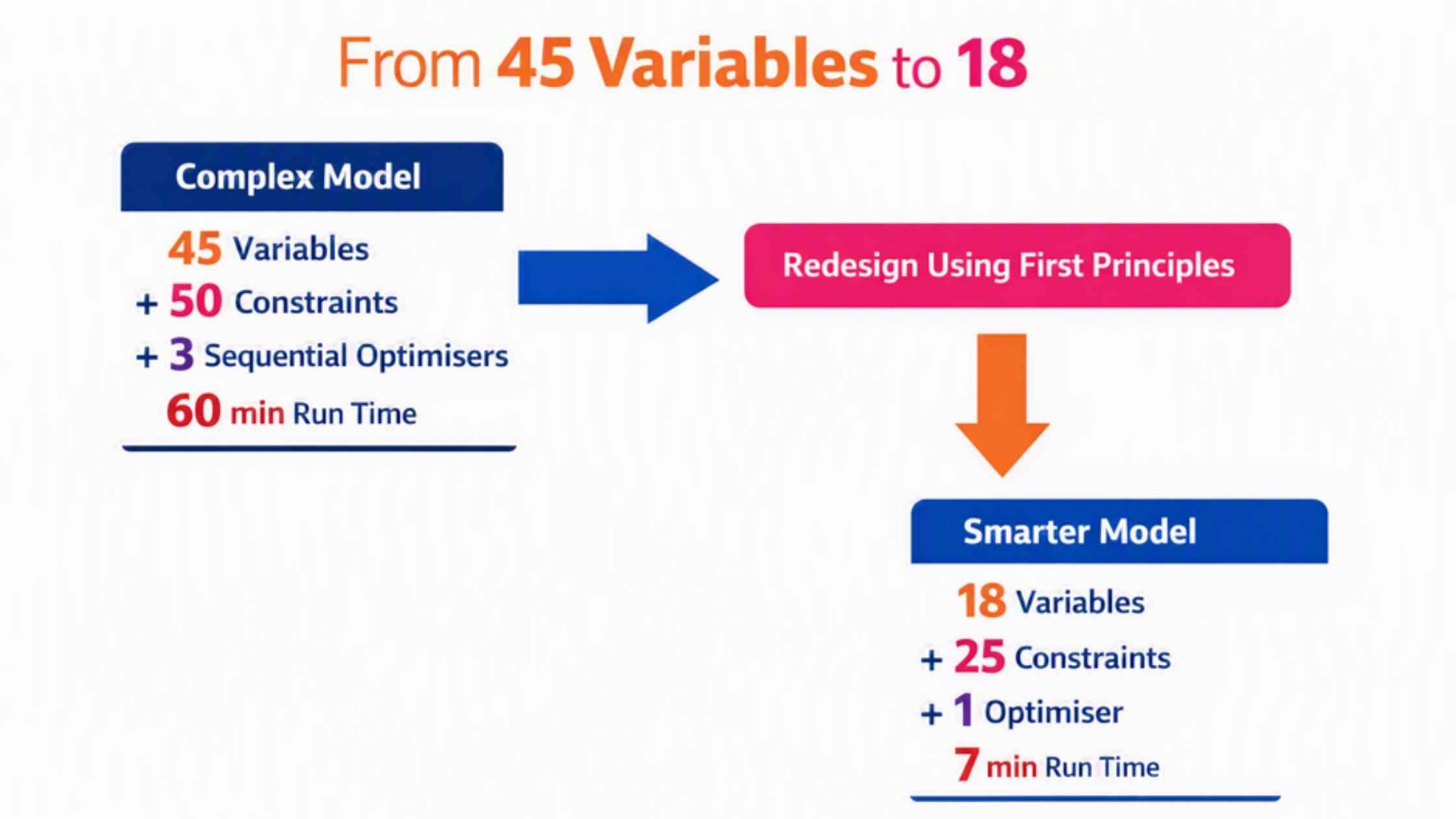
The result?
- Processing time dropped from 60 minutes to just 7 minutes. This means Customer can simulate as many scenarios on the go.
- Output quality improved dramatically
- The model became easier to maintain and explain with Proper documentation and Anaplan best practice
- Learning : Sequential Optimisation may or may not give best results
What we reduced here was the curse of dimensionality, a common pitfall in optimisation/ML modelling. A smarter design, not a bigger one, is often the key.
Final Thoughts
Optimisation is a powerful tool, but it’s not a silver bullet. A model is an abstraction of reality it’s not the reality. In Anaplan, it can be implemented elegantly and effectively, but only when the problem demands it. Think critically, prototype wisely, and always aim for clarity in design. The best models aren’t the most complex, they’re the most thoughtful.
What to read and do next
If you’ve joined the series here, you may want to start with From Pumps to Platforms: My Unlikely Journey into the World of Supply Chain, where I share how I found my way into supply chain in the first place. Then read Why Money Flow Matters in Supply Chain to explore why understanding the movement of money is just as important as understanding the movement of products.
Now it’s time to see what that means for your organisation. Take our Supply Chain Value Check to assess your current planning capabilities, uncover improvement opportunities and identify the next steps on your supply chain transformation journey.
If the picture in this piece is recognisable, we would value the exchange as much as you might. You can reach us at info@bedfordconsulting.com, or follow Bedford Consulting on LinkedIn.
Written by Nishiket Sinha
Nishiket is a Supply Chain and CPG/Retail planning specialist at Bedford Consulting, helping organisations transform demand planning, inventory management, supply planning and commercial decision-making through Connected Planning. With extensive experience delivering Anaplan solutions for complex supply chain and retail environments, Nishiket works with customers to improve visibility, increase agility and create more resilient planning processes across their organisations.