The six phases of S&OP
Share
Related Posts




The six phases of S&OP
All companies plan, but not all companies plan well. One key area that sets organisations apart from the rest is a connected, comprehensive approach to S&OP.
S&OP is a monthly integrated business management process that empowers leadership to focus on key supply chain drivers, including sales, marketing, demand management, production, inventory management, and new product introduction.
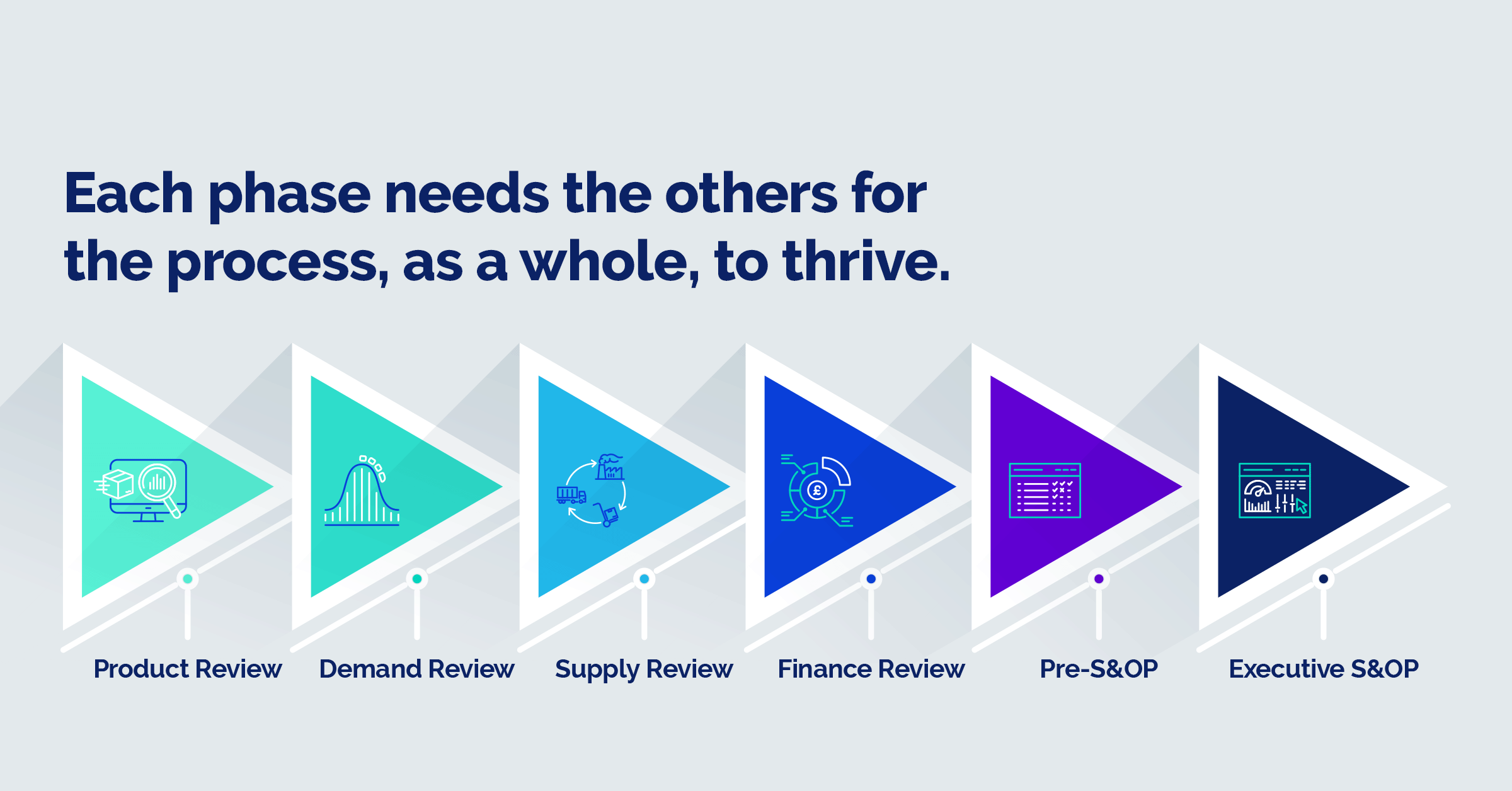
The six phases of S&OP are product review, demand review, supply review, finance review, pre-S&OP, and executive S&OP. Each phase needs the others for the process, as a whole, to thrive.
There are varying opinions on the exact order of the steps, but their effect on each other remains the same. For example, the output of product review feeds into demand review, and demand review flows into supply review. Finance review often brings adjustments to supply, demand, and product reviews, and sets up inputs for pre-S&OP and executive S&OP.
1. Product review
In the first phase, planners involved in R&D, product development, and new product introduction analyse the health of products in the market, examine product pipelines, and arrive at decisions about product planning. These decisions might include setting dates for new production or sunsetting to determine project prioritisation and resource allocation, or the impact on existing products when a new product is introduced, also known as cannibalisation, or supersession.
2. Demand review
The goal of this phase is a forecast demand plan, incorporating a holistic picture of independent and dependent demand, including factors such as marketing, new product introduction, consumer trends, product hierarchy, and interplant part demand. Historic performance will be factored into the plan, and eventually the demand plan will be compared to the results of the finance review to find any revenue or demand gaps.
3. Supply review
The goal of this phase is a supply plan that syncs with the demand plan, ideally to balance customer service and minimise inventory as well as operating costs. A baseline production plan and rough-cut capacity plan are developed, along with alternate supply plans that factor in capacity and demand variations: to reduce risk and understand the up and downsides of a wide range of adjustments. Ideally, as scenarios are developed, they’re automatically connected to budgetary needs so financial risk projections can be made.
4. Finance review
In this phase, financial performance for the previous month is consolidated to provide inputs for analysing the current month’s S&OP cycle. Finance owns this process, and can include different categories or views, including product, geography, customer, and channel. Actual costs are compared with budgets and forecasts to analyse forecast accuracy over a rolling time frame. A connected approach to S&OP means that, financial analysis plays a key role in producing inputs into pre-S&OP and executive S&OP.
5. Pre-S&OP
Pre-S&OP is a series of meetings conducted with leaders at various levels that showcase the connectivity of plans across product, demand, supply and finance to identify key gaps and disconnects and create strategies to handle those issues. The plans are reviewed in shared dashboards and actual vs. variance is analysed, keeping targets and budgets in mind. Metrics like revenue, profit, and inventory are analysed by both rolling up to the corporate level and down to the product-line to gain an understanding of the financial and operational implications of decisions. Adjustments to the product, demand, and supply plans are made in real-time.
6. Executive S&OP
The final phase of S&OP brings all plans and data together. What-if scenarios, the associated risks and decision points are noted so leadership knows when they’ll need to make the appropriate choices. Any key decisions that weren’t resolved in the first five phases are addressed in this phase, the reasons for escalation are examined, and decision deadlines are set. The decisions made in this phase can have far-reaching implications across the business. In the end, the goal of executive S&OP is to generate a final, aggregated plan that’s sent to cross-functional owners and distributed downstream to all affected areas.
For further information, including practical tips for empowering the next generation, download our S&OP guide.
What to read and do next
Go deeper: Our insight paper, The avoidable cost of disconnected supply chain planning: A Bedford perspective on where supply chain risk really builds, and how to see it earlier, brings together early warning signals, S&OP blind spots, and the connected planning model in a single gated download.
If you’re ready to have a comprehensive approach to S&OP, we would value an exchange as much as you might. You can reach us at info@bedfordconsulting.com, or follow Bedford Consulting on LinkedIn for topics related to connected planning and supply chain.