The open platform is the real headline, and it’s the part we’re already living in

Share
Related Posts



Bedford’s view on what Connect means for you
Anaplan Connect London is Anaplan’s flagship customer event, where the company sets out its product direction for the year ahead and customers see what’s coming to the platform. This year’s was dominated by one theme: AI, and specifically Anaplan’s vision for the Agentic Enterprise.
The coverage led on agents, and the agents are impressive. But for most Anaplan customers, the announcement that changes the most is quieter: Anaplan is committing to an open platform. An open ecosystem across hyperscalers, large language models, cloud data layers and evolving agentic frameworks, with a governed layer that decides how AI is allowed to touch your data.
That is the headline. And it is the part we are most excited about, because it is the part we are already working in.
Why the open platform matters
For years, the hard question with any AI capability inside a planning tool was simple to ask and awkward to answer: whose AI, running where, on whose terms, and who is watching it? An open platform answers it.
Three things make that real, and they are worth understanding, because together they turn the announcement from a demo into something you can actually deploy safely.
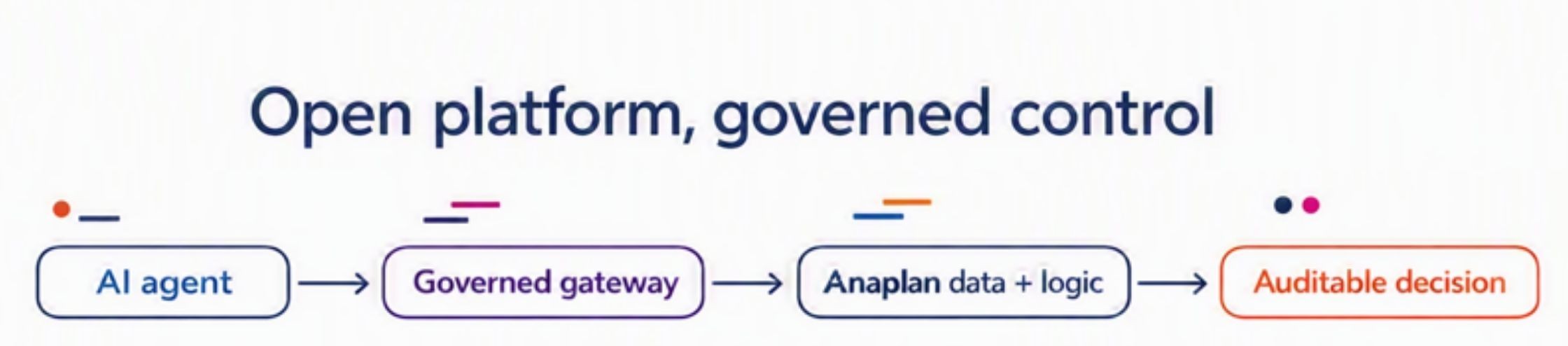
The first is open connection standards. Anaplan is supporting the common protocol the industry has settled on for connecting AI agents to tools and data, so an agent, yours or a third party’s, can reach your planning environment through a standard, governed route rather than a tangle of one-off integrations nobody can maintain.
The second is model choice. You are not tied to a single vendor’s language model. You can bring an approved model of your choosing and switch as the market moves, which it will. Your governance, your choice.
The third is the one that makes the other two safe: a governed gateway. Anaplan is introducing a control layer that sits between any agent and your data and decides what it is allowed to see and do. It handles authentication with scoped permissions, logs every action for audit, enforces role-based access, and meters and rate-limits consumption. The wider security world has converged on exactly this principle over the last year, that model guardrails alone are not enough, because they are probabilistic, so a deterministic boundary has to sit between the agent and whatever it reaches.
Which is a precise description of what Anaplan has built. The conversational layer handles the interaction. The calculation stays on Anaplan’s deterministic engine, grounded in your data and business logic, with an auditable trail behind it. LLM for the conversation. Anaplan for the calculation. Every time, the same way.
That distinction is not a slogan. It is the difference between a number an auditor can sign off and one they cannot, and it is why an LLM on its own was never going to be trusted with a figure that ends up in a board pack. An LLM is a language model, not a computation engine. Ask it the same question twice and you may get two different answers. Acceptable in a drafting tool, unacceptable in a forecast. Build business-critical decisions on an LLM alone and you are building on shifting sand: the moment you iterate, or someone else changes an input, the concurrency, context and auditability problems of a spreadsheet come straight back, with a heavy token cost on top. Anaplan keeps the numbers on bedrock.
Why this excites us specifically
Because we are already delivering it.
The pattern Anaplan is describing, an LLM handling the natural-language layer while a deterministic platform does the actual computation, is how we already work in the field. One of our consultants built a Claude-powered browser extension that our delivery teams across France, the Nordics and the UK use today, pairing conversational AI with Anaplan’s calculation engine in exactly the way the announcement points to, and built before the announcement rather than after it.
We are also named in Anaplan’s own published materials. Anaplan’s Agent Studio datasheet records Bedford as a partner already deploying CoModeler, Custom Analyst and Agent Studio with live customers, helping shorten the path from insight to action. That is not us claiming AI credibility. It is Anaplan, in its own collateral, confirming we are doing the work.
We say this not to list tools but to make a point about where the value actually sits. The technology is exciting, but technology on its own delivers nothing. The value comes from the human capital that knows how to make the two halves work together: which conversations to hand to a model, which calculations to keep deterministic, where the governed boundary sits, and who stays in the loop. AI capability multiplies what our certified experts deliver. It does not substitute for them.
Where the agents come in
Once the platform is open and governed, the agents become the payoff.
Anaplan will deliver skills-based agents for the Office of the CFO first, spanning every role in the function, from FP&A, treasury and finance operations through procurement, controllership, tax, audit, risk, investor relations and corporate development. Suites for supply chain, human resources and sales are expected to follow.
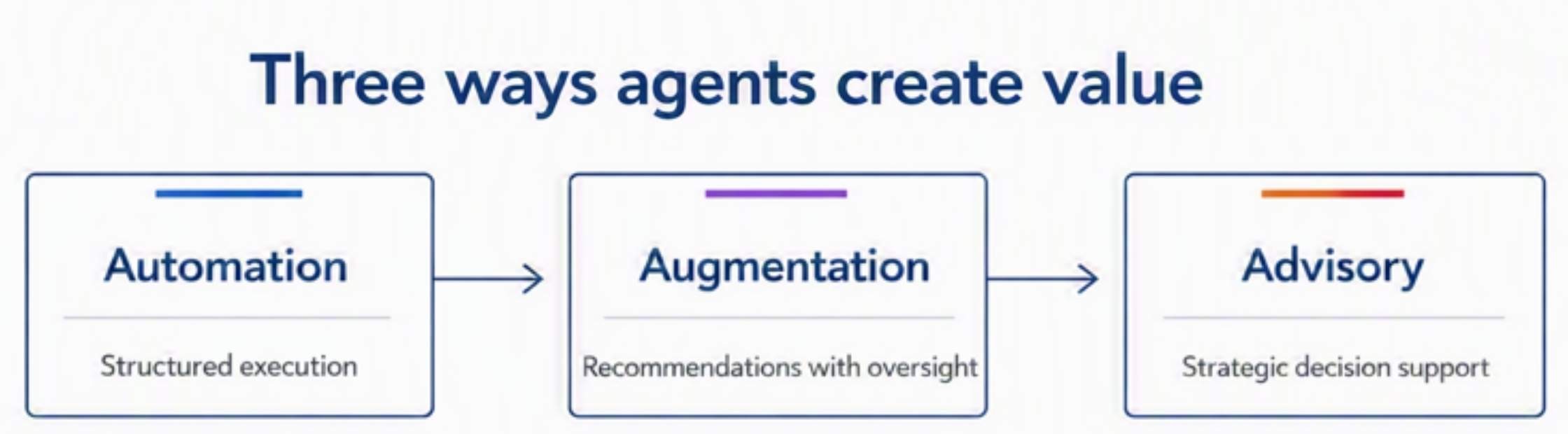
Crucially, these agents are not one undifferentiated thing. They fall into three types, and the distinction is the whole game. Automation agents take on highly structured work where the decision logic is well understood and execution can be governed: refreshing a forecast on new actuals, running a scenario. Augmentation agents combine structured workflows with analytical reasoning, gathering data and offering recommendations while a person makes the call. Advisory agents support complex, strategic work where AI accelerates the analysis but human judgement drives the final decision.
The important part, and the reason this is a trust story rather than a speed story, is that each agent’s degree of autonomy is configurable to match your organisation’s risk appetite. That is the mechanism that lets you adopt agents without handing over decisions you are not ready to hand over.
What determines whether this delivers for you
Here is the one thing that decides whether all of this creates value or exposes you: agents inherit the model they are given.
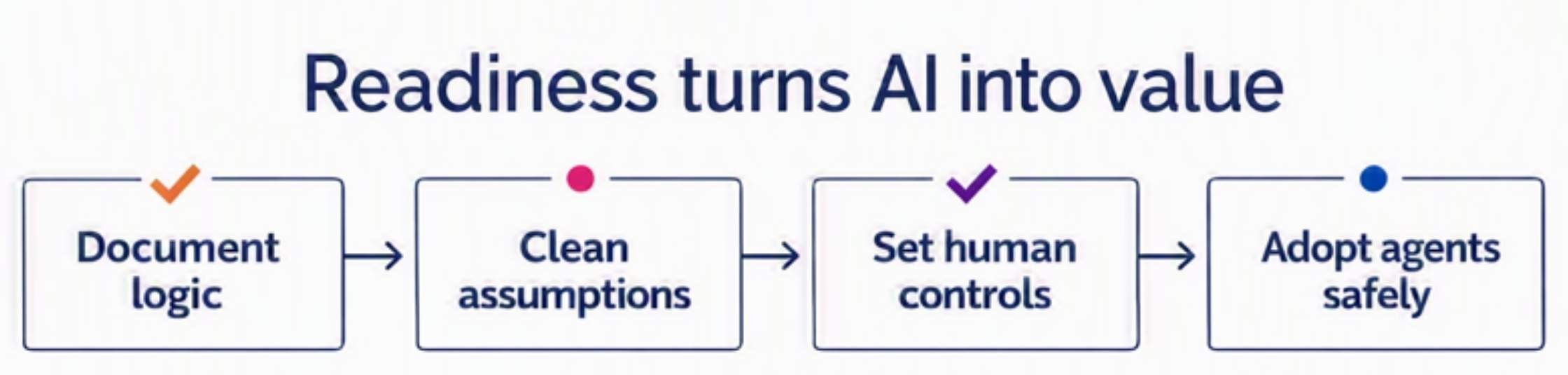
A well-run planning environment, with documented logic, current assumptions and a clean audit trail, is one where agents land smoothly, because everything they need is already in good order. A model that has drifted, full of undocumented workarounds and assumptions nobody remembers setting, is one where agents will faithfully and rapidly act on logic that no longer holds. AI does not introduce weakness into a planning environment. It industrialises whatever weakness is already there.
The good news is that getting ready is not a new or exotic project. It is the same work that makes month-end faster, handovers survivable and audits less painful. It is what Bedford Advantage does: regular review, documented improvements, steady optimisation, so the model you have invested in stays accurate, current and ready for whatever you connect to it.
The open platform makes the excitement possible. The readiness of your model turns it into value. And the human capital in between, the expertise that knows how to combine conversation and calculation safely, is what we bring.
The role of the planning expert is changing, and that is the opportunity
It is worth naming what this does to the people who run planning. As agents take on more of the mechanical modelling and data-wrangling, the value of a planning expert shifts from execution knowledge to judgement and outcome ownership. Less time on how to build the thing, more on whether it is the right thing and what to do about what it tells you.
That is not AI replacing planners. It is AI raising what a planner is expected to deliver. The underlying model, Claude, Gemini, Copilot or Anaplan’s own, becomes a swappable component. What endures, and what clients are actually buying, is the delivery expertise applied on top of it, consistently, whichever model sits underneath. Swap the model, keep the expertise.
What to do with the runway
The agentic portfolio is arriving in stages, and the governed gateway that ties it together is expected later this year. That sequencing is useful: it gives you a window before agents are live across your planning environment. Use it well.
Get your model in order first. Documented logic, current assumptions, clean data lineage. This is the single highest-value thing you can do before any agent arrives, and it is the foundation everything else depends on.
Decide where the human stays. For each process, work out what to automate, what to augment, and what stays a human call, and set those thresholds deliberately rather than discovering them during an incident.
Think about your model choice. An open platform gives you a real decision about which language model you bring. Start that conversation with your security and data teams now, not when the gateway goes live.
And talk to us. We are already working this way, and helping you get ready is precisely the work we do.
Our position
This is a genuinely exciting moment, and we are optimistic about it, because the direction Anaplan has set is the right one. An open platform, a deterministic core, a governed boundary, and agents that free people to do the work only people can do.
What turns that from an announcement into an advantage is the unglamorous work underneath, and the human judgement that knows how to combine the pieces. Keeping the model sound. Choosing where the human stays. Making conversation and calculation work together, safely, every time. That is what we do, it is how we already work, and after more than a decade as Anaplan’s Partner of the Year, across 1,100 projects for over 500 customers, it is work we have done more times than almost anyone.
The platform is open. The roadmap is real. Let’s make sure you are ready to get the most from it.
What to read and do next
Where to start. Our Anaplan Value Check takes two minutes and ten questions. It assesses the strength of your planning foundations, shows you where the gaps are, and gives you a practical view of what to address first.
If the picture in this piece is recognisable, we would value the exchange as much as you might. You can reach us at info@bedfordconsulting.com, or follow Bedford Consulting on LinkedIn.