Why your forecast was wrong again – and why it’s not your team’s fault

Share
Related Posts




Bedford Consulting | The confidence gap series
Picture the scene. It’s Thursday morning. The CFO is standing in front of the board with a forecast that took four weeks to produce. She already knows the number is wrong. Not because anyone made an error, but because the world moved while the spreadsheet didn’t.
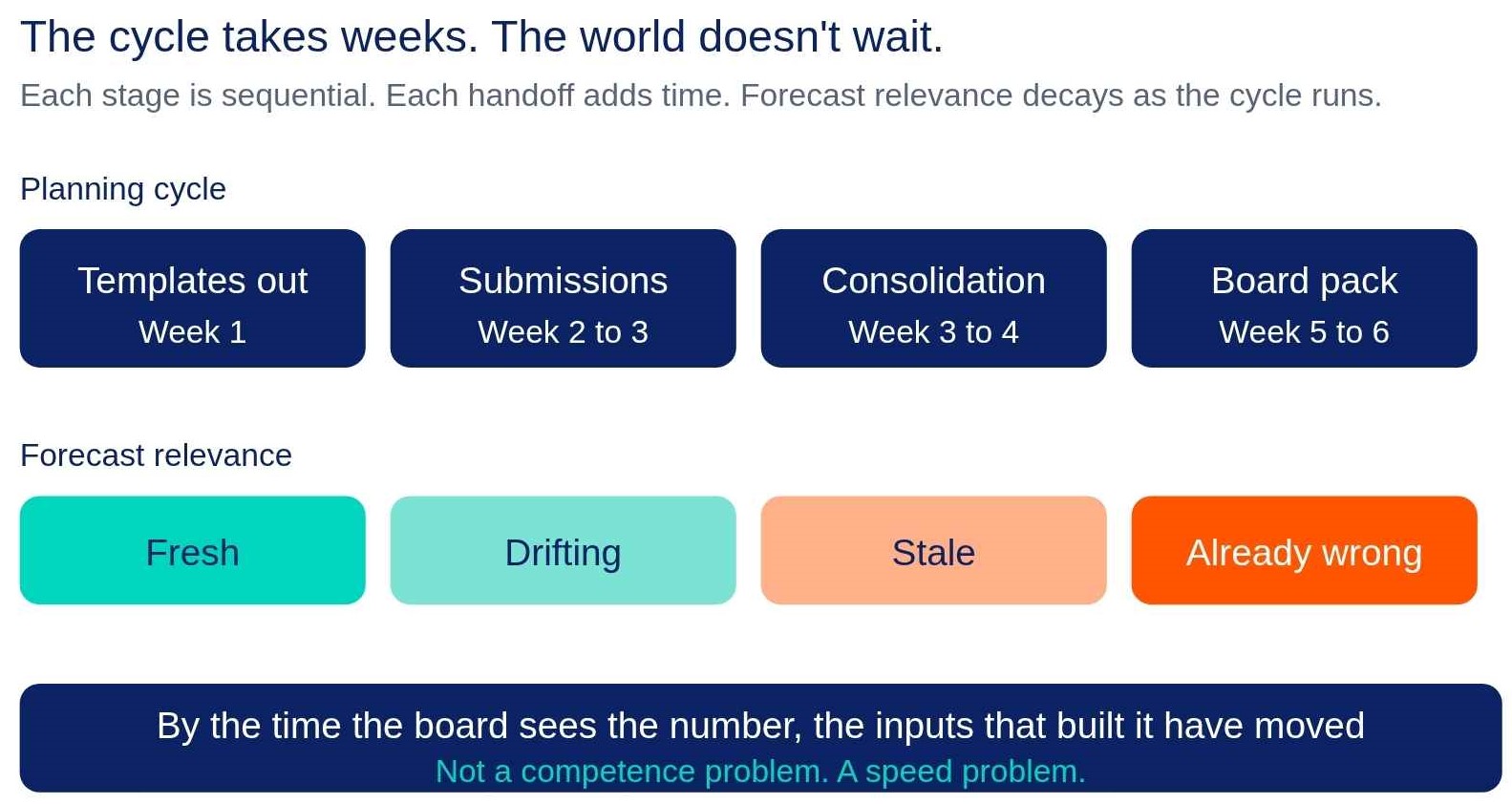
This is the moment that defines financial planning for most mid-market businesses. Not a failure of competence, but a failure of speed. The planning cycle takes weeks. Assumptions get locked early. By the time FP&A has collected inputs from every department, consolidated them manually, and run the numbers through a chain of linked spreadsheets, the inflation figure has shifted, the exchange rate has moved, and the demand signal that underpinned the whole thing has quietly changed shape.
The forecast isn’t wrong because someone got lazy. It’s wrong because the process that produced it was designed for a world that sat still.
The structural lag nobody talks about
Most mid-market planning cycles run three to six weeks end to end. That’s three to six weeks of sequential data collection, departmental submissions, manual consolidation, and senior review. Each stage adds time. Each handoff adds risk. And the further a forecast gets from its anchor date, the weaker its relevance becomes.
Consider what happens in practice. Finance sends out templates. Business units fill them in using actuals that are already a week or two old. Commercial inputs and financial consolidation happen sequentially, not in parallel, so by the time the revenue line reflects what sales is seeing, the cost base has already been locked. Then a senior stakeholder asks for one more scenario, and the whole timeline resets.
The result is a forecast built on assumptions that expired before the ink dried. Not because the team was slow, but because the architecture of the process makes speed impossible.
The external shocks that keep rewriting the script
Even the best-designed planning process would have struggled with the past 18 months. Interest rate fluctuations have rewritten debt servicing assumptions mid-cycle. Energy price swings have hit manufacturing and logistics-heavy businesses without warning. Sterling has lurched against both the dollar and the euro, catching treasury teams between hedging windows. And policy shifts on trade, tariffs, and national insurance have landed with little notice and wide impact.
One Bedford client saw the value of connected planning in sharp relief during the national insurance change. Their headcount model, built on Anaplan, gave them an instant read on the cost impact that would have taken a spreadsheet-based team weeks and multiple people to calculate. That’s the difference between responding and reacting.
Where blame lands (and where it should)
When a forecast misses, the post-mortem follows a familiar pattern. Finance gets blamed for getting the numbers wrong. FP&A is labelled too slow or too conservative, depending on which way the miss went. Commercial teams are accused of over-optimistic pipeline assumptions. Operations take heat for not delivering efficiency targets.
What rarely gets blamed is the system itself. The tools, the process, the structural constraints that made accuracy near-impossible in the first place. Instead, the finger-pointing creates an “us and them” dynamic: budget holders blame pressure from above, while CFOs hear whispers of sandbagging from below. Ownership of the assumptions dissolves. Nobody wants to own the drivers when the drivers keep changing and the tools can’t keep up.
The reforecast bottleneck
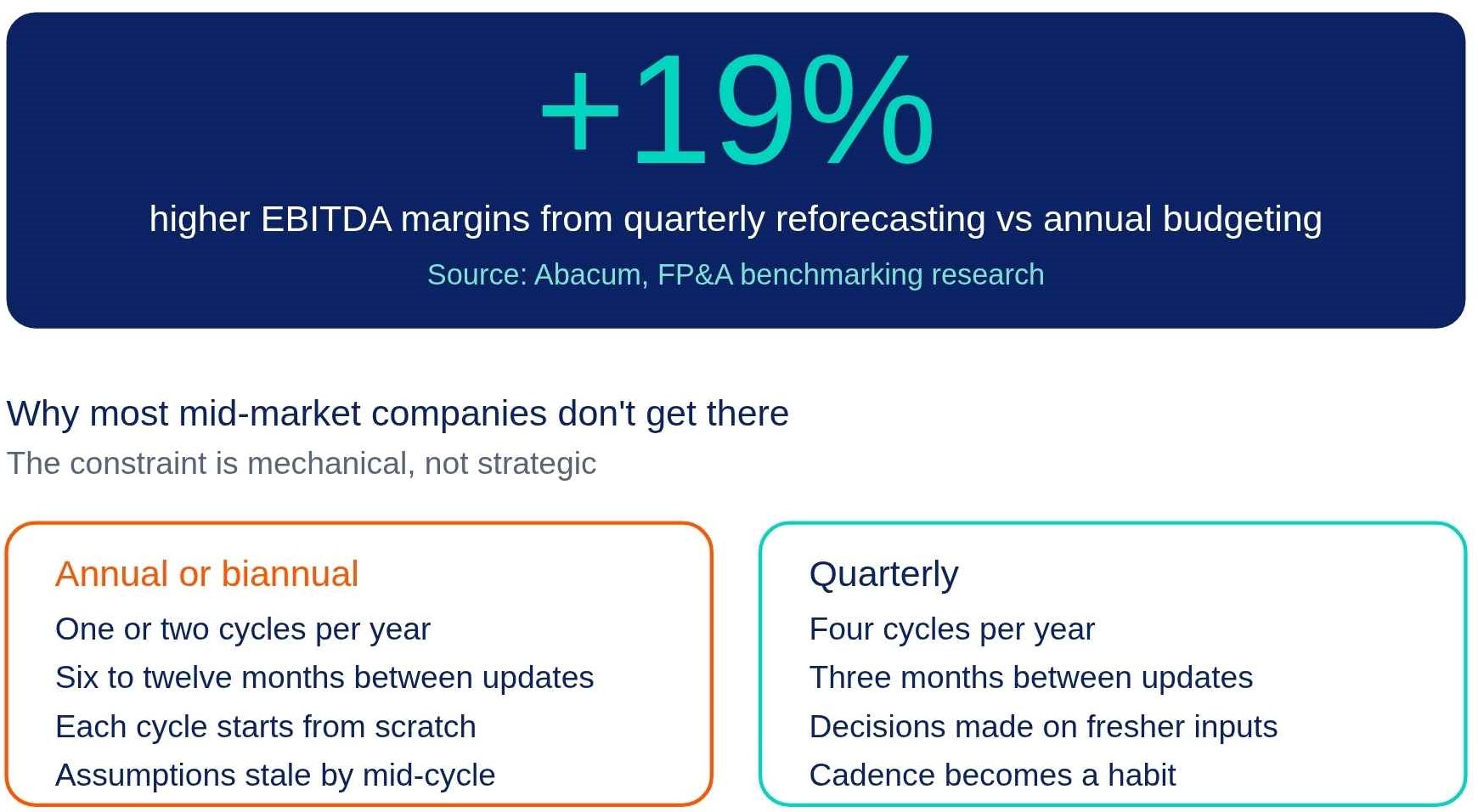
Here’s where the confidence gap becomes most visible. Most mid-market companies reforecast only two or three times a year. Not because that’s strategically optimal, but because each cycle takes so long that more frequent updates are physically impossible.
The constraint is mechanical: the time it takes to distribute clean templates, collect submissions, re-link spreadsheets, vet the inputs, and consolidate the output. Research from Abacum found that organisations reforecasting quarterly see 19% higher EBITDA margins than those sticking to annual budgets. The mid-market knows this intuitively. But knowing you should reforecast more often and actually being able to are two very different things when your planning infrastructure runs on email attachments and Excel.
What CFOs actually say
The frustration is remarkably consistent. We hear variations of the same thing across almost every finance engagement:
“By the time I present this to the board, I already know it’s wrong.”
“We spend a month producing a number we don’t trust.”
“We can’t answer simple ‘what if’ questions without going back to the model for a week.”
“Every reforecast feels like starting from scratch.”
“We’re debating assumptions more than making decisions.”
That last one matters most. When the planning process consumes so much time and energy that it crowds out the decisions it was supposed to inform, something fundamental has broken. The forecast has become an end in itself rather than a tool for action.
This is the confidence gap
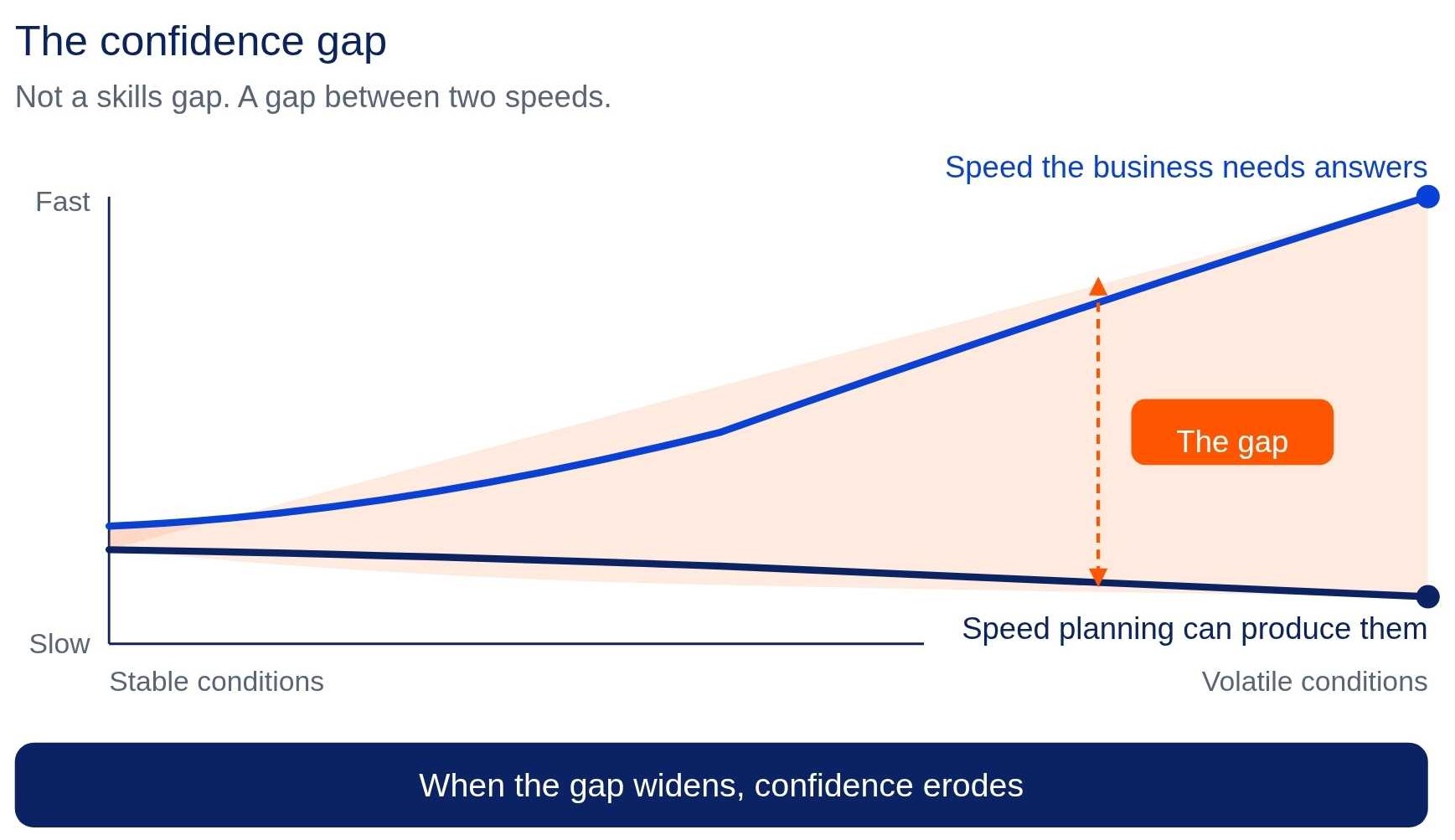
The real cost isn’t forecast inaccuracy. Every CFO knows the number will be wrong to some degree. The real cost is the erosion of confidence: in the forecast, in the process, in the team’s ability to respond when conditions change. When a board loses faith in the numbers, decisions slow down. When FP&A loses faith in the tools, workarounds multiply. When the CFO loses faith in the cycle, planning becomes a compliance exercise rather than a strategic advantage.
This is what we mean by the confidence gap. Not a skills gap. Not a technology gap in the obvious sense. A gap between the speed at which the business needs to make decisions and the speed at which the planning function can produce answers worth trusting.
Closing that gap starts with recognising that the problem is structural, not personal. Your team isn’t failing. Your process is.
What to read and do next
Want to see where your planning function stands? The Confidence Grader is a 3-minute diagnostic that scores your planning maturity across five dimensions — and shows you exactly where speed, visibility, and confidence can be built. Take the Confidence Grader →
Want the full picture first? Download our insight paper, Closing the Confidence Gap — a practical framework for CFOs navigating the shift from fragmented planning to connected planning. [Download the insight paper →
Next in the series: The Excel ceiling – when your most important planning tool becomes your biggest liability.
Get in touch to discuss how to identify why your forecast is going wrong.
Chris Brooks is a Principal Consultant at Bedford Consulting, specialising in financial planning and supporting organisations to improve forecast accuracy, agility, and decision confidence. He works closely with finance teams to design and deliver connected planning solutions that move beyond manual, spreadsheet‑driven processes, enabling faster, more responsive ways of working. With a pragmatic, business‑first approach, Chris focuses on ensuring planning solutions are clear, scalable, and deliver measurable value across the organisation.