Why money flows matter in Supply Chains

Share
Related Posts



Bedford Consulting | Planning through the Fog Series
This is the second article in the series I promised in my previous piece. Today’s topic may sound familiar, but it is rarely discussed in supply chain implementations: Supply Chain Finance (SCF).
As always, I try to write my articles with a specific audience in mind. For this article, I would like you to read it not from the perspective of an implementation engineer, but through the lens of a CFO, Finance Manager, or Supply Chain Head—people who must manage operations while focusing on balance sheets, cash flows, and financial performance.
Supply Chain Finance is a broad subject. My objective here is not to cover everything, but to provide enough foundational knowledge and terminology to spark your curiosity and encourage further exploration.
As a supply chain professional, you will also see how financial considerations influence decisions when designing supply chain processes and systems.
In short: What choices do supply chain professionals have when designing operations, and how do those choices impact financial statements?
Bonus: Unlike some of my previous articles, this one is not about personal experiences, implementation successes, or failures. It is focused entirely on the business subject itself.
Before You Read
It will help if you are familiar with:
- Basic accounting principles
- Balance Sheets
- Income Statements
- Cash Flow Statements
- Depreciation (a non-cash expense)
- Working Capital
- Cash Conversion Cycle (CCC)
Defining Supply Chain Finance
To understand SCF, let’s start with the basics.
When designing supply chains, we typically think about three flows:
- Physical Flow – movement of goods
- Information Flow – movement of data
- Financial Flow – movement of money
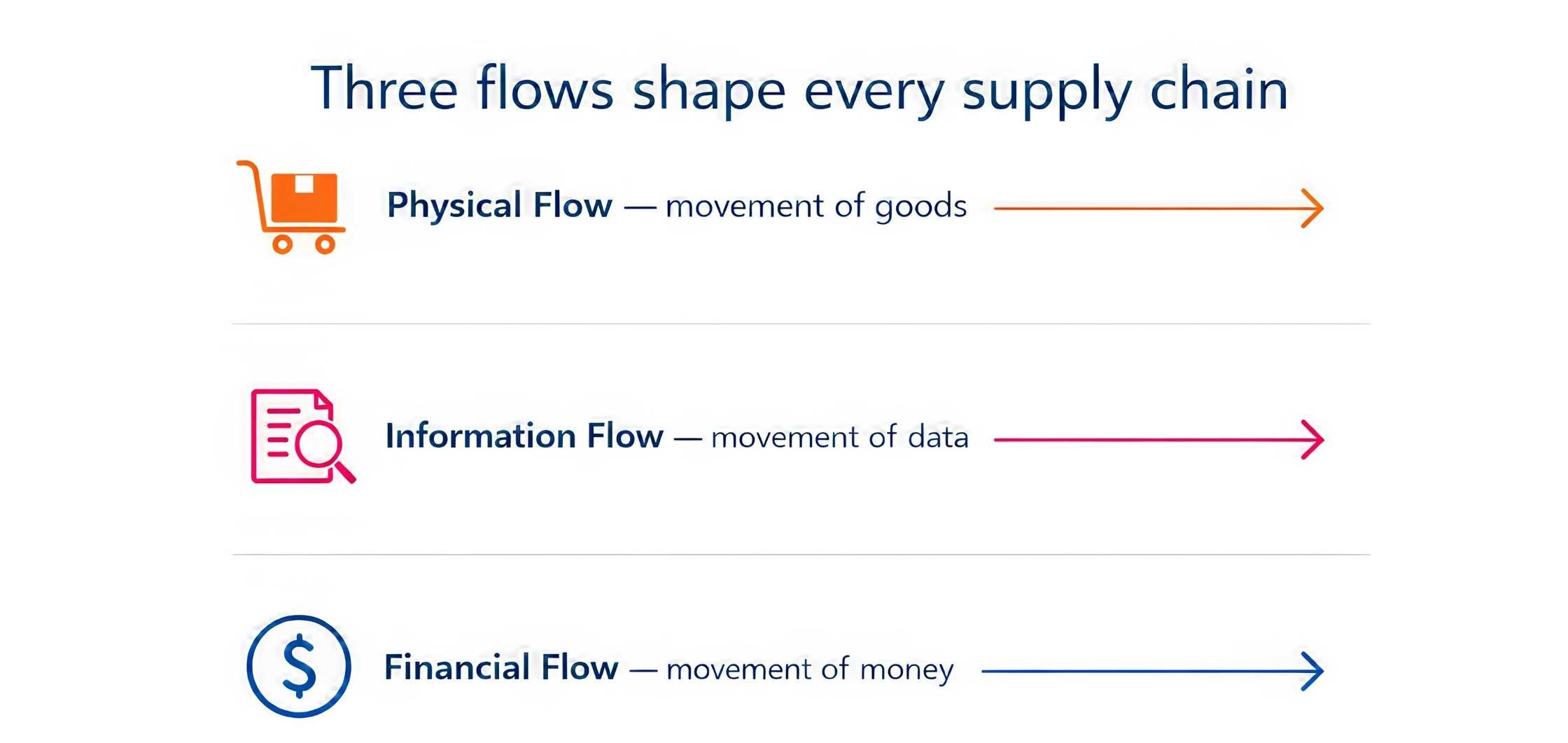
Supply Chain Finance is concerned with the financial flow. It manages capital, investments, liquidity, and future cash flows across the supply chain.
In a typical supply chain:
Customer → Retailer → Distributor → Manufacturer → Supplier
SCF ensures sufficient cash is available at every stage so that products continue to flow smoothly. It helps organisations understand the financial impact of supply chain transactions and how supply chain decisions affect financial statements.
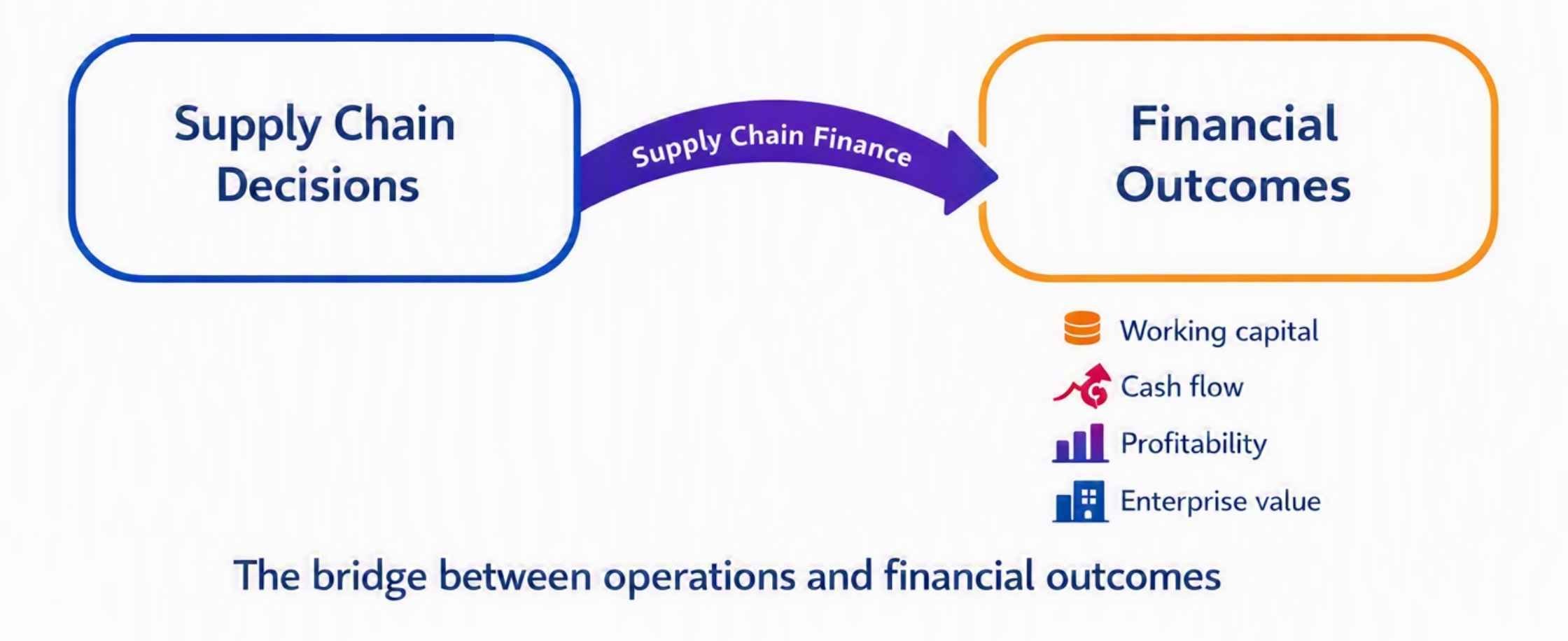
As supply chain practitioners, we often operate in a world of inventory turns, cycle times, service levels, and asset management. Senior executives, however, tend to think in terms of revenue, profitability, cash flow, and working capital. Talk about inventory turns and their eyes may glaze over. Talk about working capital, revenue impact, or cash flow, and suddenly you have their attention. This is where Supply Chain Finance becomes valuable, it creates the connection between operational decisions and financial outcomes.
To understand that connection, we will look at:
- Income Statement and Balance Sheet
- Working Capital
- Cash Conversion Cycle (CCC)
- Days Inventory Outstanding (DIO)
- Days Sales Outstanding (DSO)
- Days Payables Outstanding (DPO)
Connecting Supply Chain Transactions to Financial Reports
Financial Reports
Let’s simplify this with a straightforward example. Suppose a company sells a product for $10,000, and the product cost is $2,000. The transaction:
- Increases revenue by $10,000
- Increases cash by $10,000
- Reduces inventory by $2,000
- Increases retained earnings by $8,000
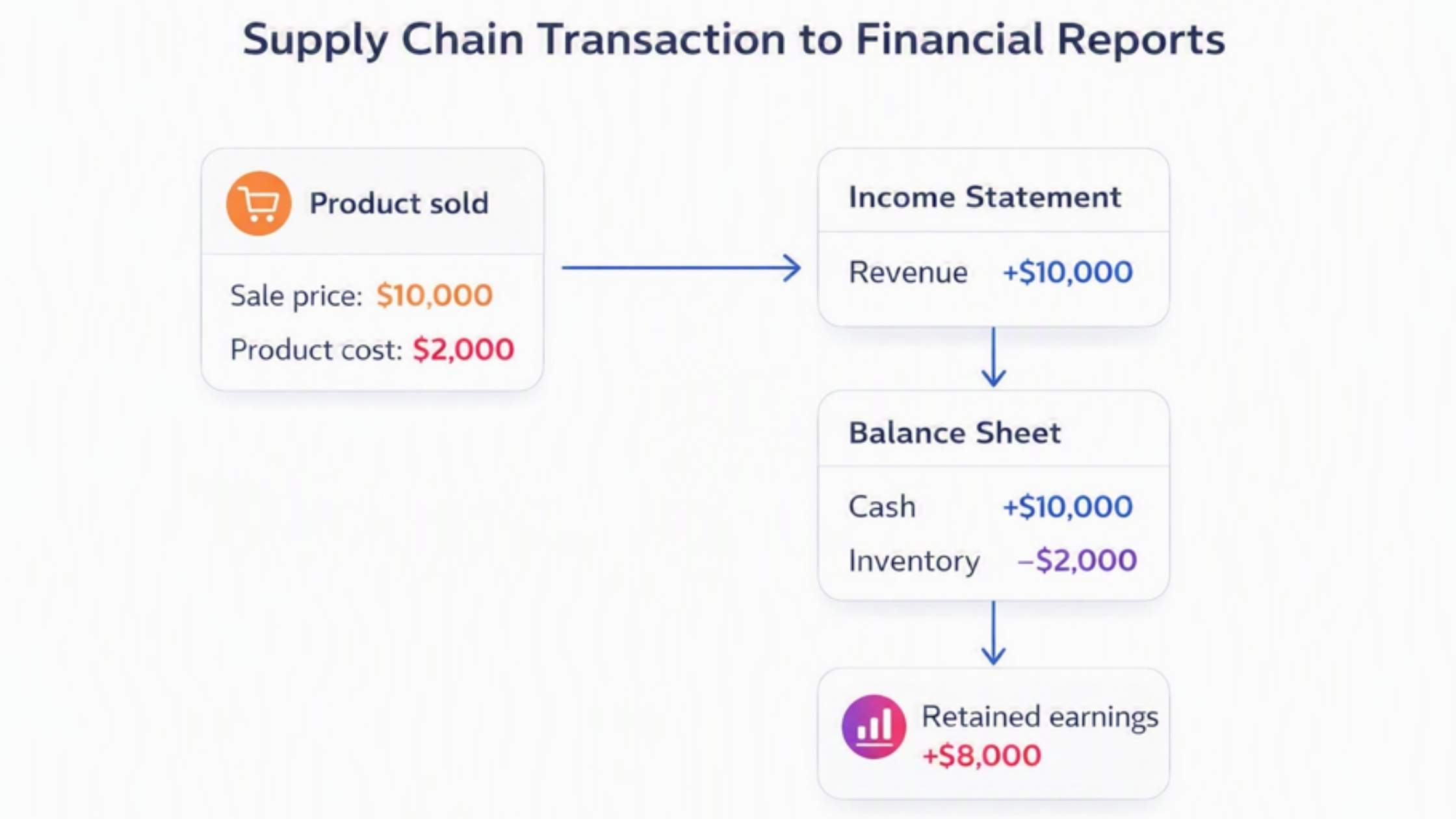
Understanding these accounting fundamentals allows supply chain professionals to communicate more effectively with business leaders and appreciate the financial consequences of operational decisions.
Working Capital (WC)
Working Capital represents the financial resources used to run day-to-day operations.
It primarily consists of:
- Cash
- Accounts Receivable
- Inventory
- Accounts Payable
The major supply chain elements affecting working capital are:
Inventory
Products sitting in a warehouse are essentially cash sitting on shelves. The more inventory you hold, the more money is tied up, leaving less cash available elsewhere in the business.
Accounts Receivable
This is money customers owe you. When customers take longer to pay, cash remains locked up and unavailable for other uses.
Accounts Payable
This is money you owe suppliers. If payments can be delayed appropriately without harming supplier relationships, businesses can retain cash for longer and deploy it elsewhere. Supply Chain Finance aims to optimise all three.
Working Capital Formula
Working Capital = Current Assets − Current Liabilities
If Working Capital is positive, the business generally has enough current assets to support ongoing operations. If it is negative, it may indicate that the business lacks sufficient resources to meet short-term obligations, potentially leading to credit issues or, in extreme cases, bankruptcy. However, negative working capital is not always bad. Some businesses intentionally operate with negative working capital. Think about subscription-based businesses or companies that receive customer payments upfront before delivering products or services.
Question for thought: What working capital ratios are generally considered healthy industry benchmarks?
Cash Conversion Cycle (CCC)
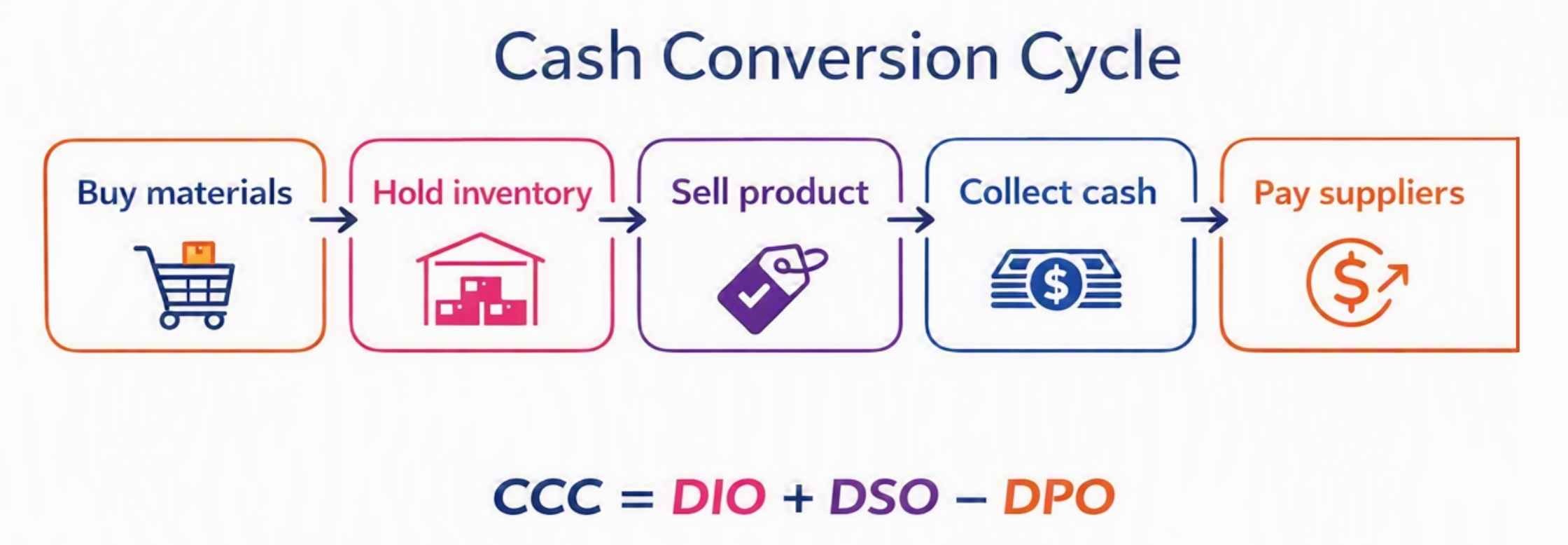
The Cash Conversion Cycle (CCC) measures the number of days required for a company to:
- Purchase materials
- Produce products
- Sell products
- Collect payment from customers
In simple terms, it measures how long cash remains tied up in operations. A shorter cash conversion cycle is generally preferable because it means the company converts investments back into cash more quickly, improving liquidity and financial flexibility.
Formula
CCC = DIO + DSO − DPO
Days Inventory Outstanding (DIO)
DIO measures how long inventory remains in the business before being sold. Generally, a lower DIO is better because inventory is moving faster.
Formula
DIO = (Average Inventory / Cost of Sales) × 365
Inventory is recorded at cost; therefore, Cost of Sales is used in the calculation.
Question for thought: Can you think of situations where a company might intentionally maintain a higher DIO?
Days Sales Outstanding (DSO)
DSO measures how long it takes to collect payment from customers after a sale. It represents the average number of days required to convert receivables into cash. Generally, a lower DSO is preferable.
Formula
DSO = (Average Accounts Receivable / Total Sales) × 365
Note that Accounts Receivable consists of credit sales, not cash sales.
Days Payables Outstanding (DPO)
DPO measures the average time a company takes to pay suppliers. Generally, a higher DPO is beneficial, provided it does not damage supplier relationships.
Formula
DPO = (Average Accounts Payable / Cost of Sales) × 365
Since supplier transactions are recorded at cost, Cost of Sales is used as the denominator.
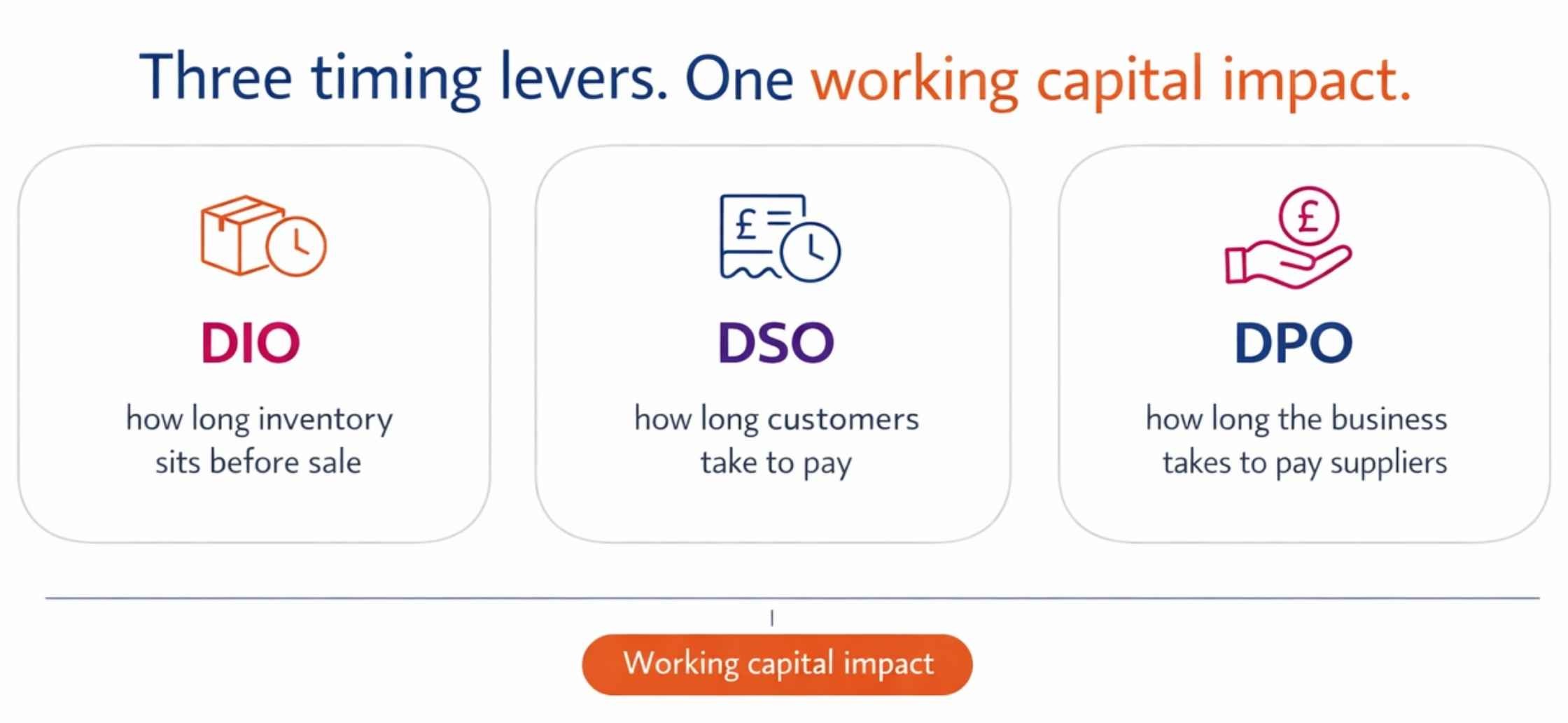
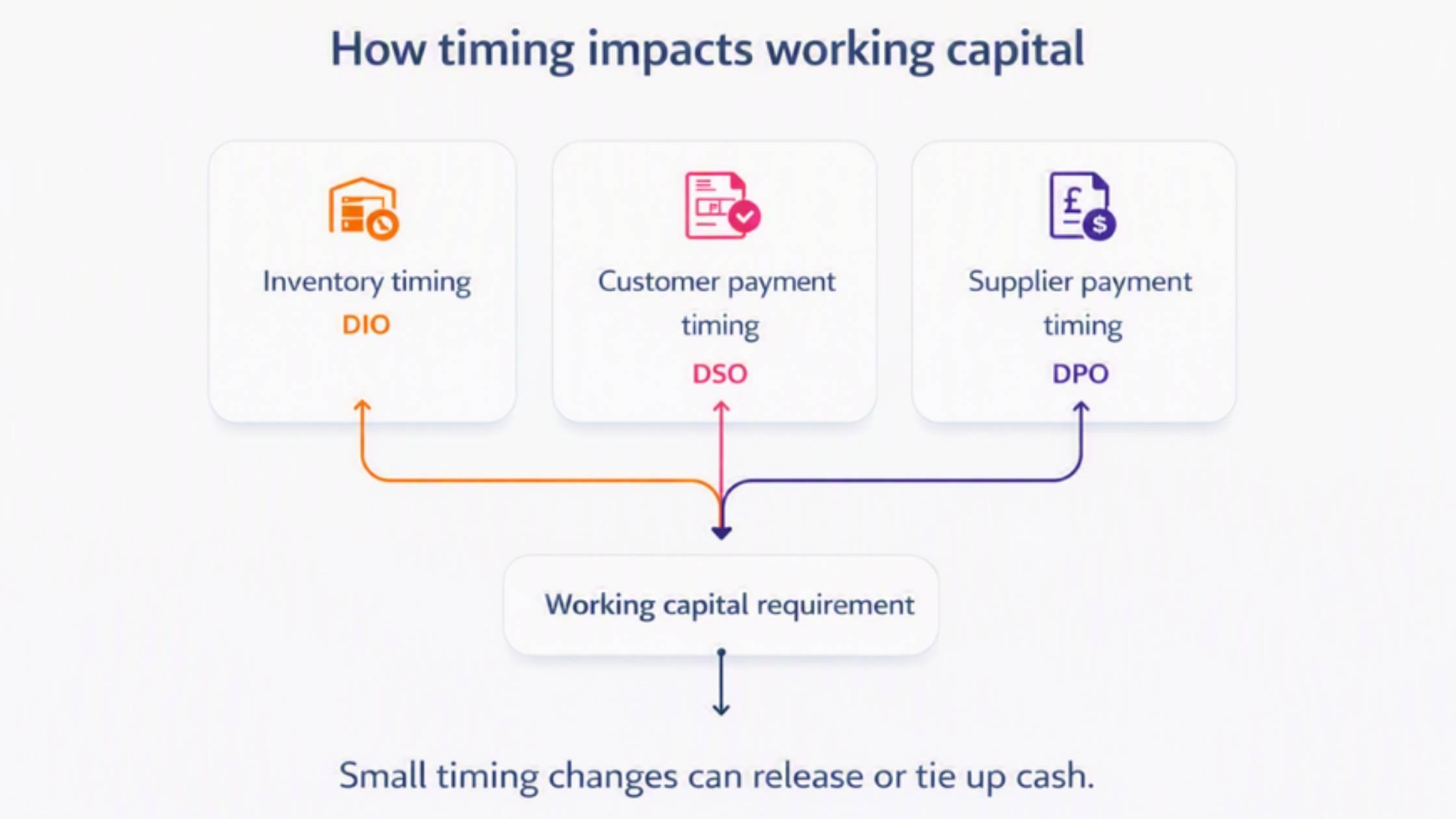
The Cash Conversion Cycle directly influences working capital requirements.
By changing the timing of even one element, inventory movement, customer payment terms, or supplier payment terms, a company can significantly alter:
- The amount of cash tied up in operations
- The duration of financing requirements
- The overall working capital requirement
Before moving to the next section, think about all the balance sheet and income statement elements that feed into these ratios. Doing so will help you understand how supply chain decisions ultimately affect financial performance.
This is the bridge between Supply Chain and Finance.
| Supply Chain Finance Practice | Standard SCF Objective | Impact on Working Capital | Advantages | Disadvantages |
| Extended Payment Terms from Suppliers | Delay payment to suppliers (increase DPO) | Reduces working capital requirement by delaying cash outflow | Improves liquidity and cash conversion cycle | Suppliers may increase prices or reduce service levels |
| Early Payment Discount from Customers | Accelerate collection from customers (reduce DSO) | Improves working capital by accelerating cash inflow | Faster cash collection and improved liquidity | Reduced revenue due to discount offered |
| Financing Raw Materials & WIP for Small Suppliers | Protect supplier cash flow and ensure supply continuity | Improves supplier liquidity but may increase buyer financing exposure | Reduces supplier risk and supports supply reliability | Additional funding requirements and liabilities |
| 3PL Financed Vendor Managed Inventory (VMI) | Reduce inventory ownership (reduce DIO) | Lowers inventory recorded on balance sheet | Reduces inventory investment and working capital needs | Additional 3PL service costs |
| Early Payment Discounts to Suppliers | Reduce procurement cost through payment incentives | Increases short-term cash usage | Lower material cost and stronger supplier relationships | Reduces available liquidity |
| Extended Payment Terms for Customers | Increase sales and customer attractiveness | Increases accounts receivable and working capital needs | Can drive additional sales volume | Delays cash receipt and increases financing requirements |
| Extended Payment Terms for Customers | Increase sales and customer attractiveness | Increases accounts receivable and working capital needs | Can drive additional sales volume | Delays cash receipt and increases financing requirements |
Why Supply Chain Finance Became Important
Historically, companies focused heavily on operational efficiency by reducing:
- Manufacturing costs
- Transportation costs
- Inventory costs
However, after repeated financial crises, particularly the 2008 financial crisis, organisations realised that cash availability is just as important as operational efficiency.
A supply chain can be operationally excellent and still fail if suppliers do not have sufficient liquidity to survive.
As a result, Supply Chain Finance programs gained significant importance, with a focus on:
- Liquidity management
- Working capital optimisation
- Supply chain resilience
This is the essence of how Supply Chain Finance connects to Supply Chain Design.
Traditionally, supply chain design answers questions such as:
- Where should factories be located?
- How many warehouses should we have?
- How much inventory should be held?
- Which suppliers should we use?
Supply Chain Finance introduces an additional question:
What is the cash impact of these design decisions?
For example:
Option A
- 10 warehouses
- Higher inventory
- Faster customer service
Option B
• 5 warehouses
• Lower inventory
• Less cash tied up
Traditional supply chain analysis may focus primarily on logistics costs.
Supply Chain Finance expands the analysis to include:
- Logistics costs
- Inventory investment
- Working capital requirements
- Cash flow impact
- Return on investment (ROI)
This creates a much more complete view of supply chain performance and enables organisations to make decisions that are operationally efficient and financially sound.
Final Thought
Supply Chain professionals often optimise the movement of products, while Finance professionals optimise the movement of cash. Supply Chain Finance is the discipline that connects these two worlds, helping organisations understand how operational decisions ultimately influence working capital, cash flow, profitability, and enterprise value.
PS: If you managed to think through all the questions I left in the article (negative working capital, high DIO scenarios, and working capital benchmarks), you’re already doing Supply Chain Finance, not just reading about it.
What to read and do next
Go deeper: Our insight paper, The avoidable cost of disconnected supply chain planning: A Bedford perspective on where supply chain risk really builds, and how to see it earlier, brings together early warning signals, S&OP blind spots, and the connected planning model in a single gated download.
If the picture in this piece is recognisable, we would value the exchange as much as you might. You can reach us at info@bedfordconsulting.com, or follow Bedford Consulting on LinkedIn for the next piece in this series on connected planning in automotive and industrial manufacturing.
Written by Nishiket Sinha
Nishiket is a Supply Chain and CPG/Retail planning specialist at Bedford Consulting, helping organisations transform demand planning, inventory management, supply planning and commercial decision-making through Connected Planning. With extensive experience delivering Anaplan solutions for complex supply chain and retail environments, Nishiket works with customers to improve visibility, increase agility and create more resilient planning processes across their organisations.