Why your S&OP process is creating the risks it’s supposed to prevent

Share
Related Posts




Bedford Consulting | Planning through the Fog Series
Sales & Operation Planning (S&OP) exists to connect the dots across your business. But when it stalls – and it stalls more often than most leaders realise – it doesn’t just stop adding value. It actively creates the blind spots, delays, and misalignment that put your supply chain at risk.
In our last post, we explored the early warning signals that most supply chain organisations miss. The supplier performance drift, the demand pattern shifts, the macro indicators that never reach the planning process. If you recognised your own organisation in that picture, the next question is: why?
The answer, more often than not, is S&OP. Not the absence of it – most organisations we work with have an S&OP process. The problem is that it’s not doing what it was designed to do. In fact, in many cases, it’s making things worse.
That’s a provocative claim, so let us explain what we mean.
How S&OP programmes lose their grip
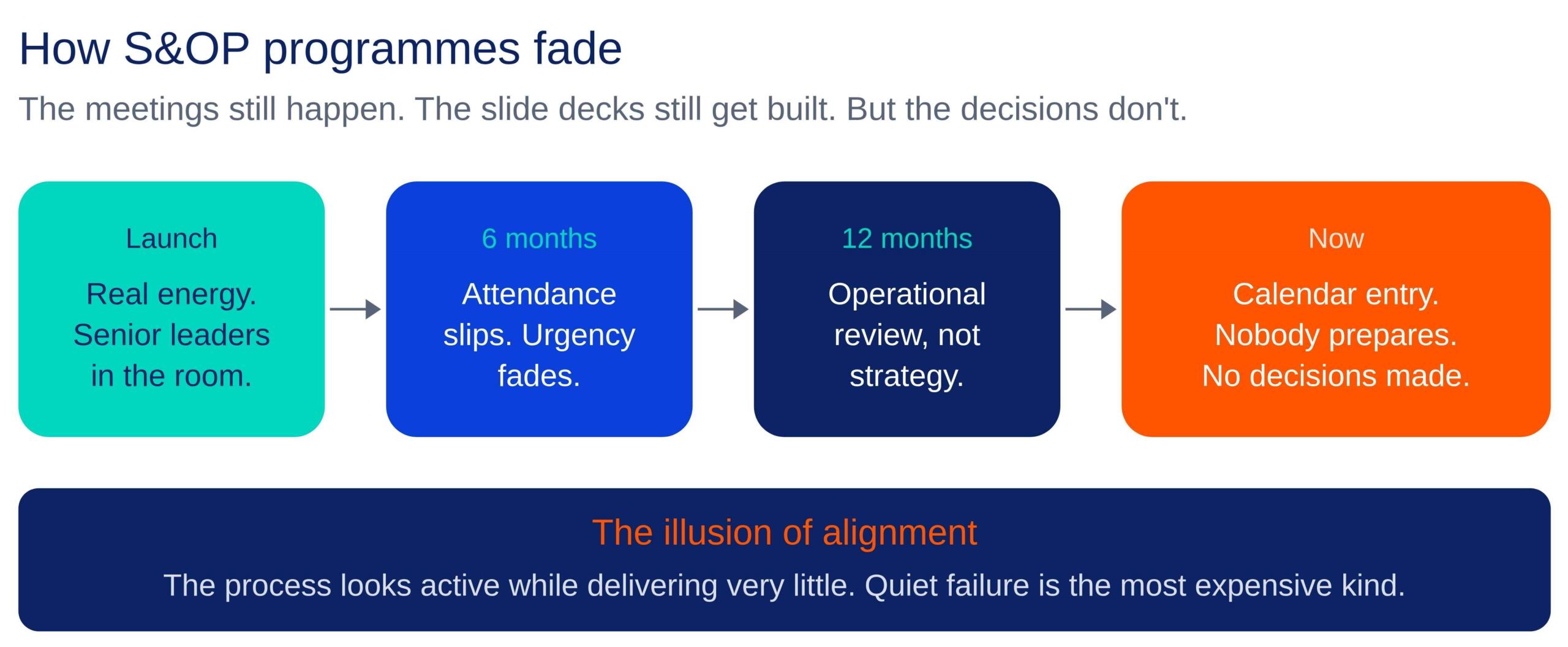
Most S&OP programmes don’t fail dramatically. There’s rarely a single moment where someone declares the process broken. Instead, they fade. Slowly, incrementally, and almost imperceptibly.
It starts with attendance. A senior leader misses a meeting. Then another. The meetings continue, but the people with decision-making authority stop showing up. What was a strategic conversation becomes an operational review. Then it becomes a reporting exercise. Then it becomes a calendar entry that nobody prepares for properly.
We see this pattern repeatedly. The process was launched with real energy – perhaps off the back of a disruption or a new leadership mandate. But six months in, the urgency has faded. The disciplines that made it effective – cross-functional preparation, structured escalation, scenario analysis – start slipping.
The meetings still happen. The slide decks still get built. But the decisions don’t. And that’s the critical distinction: a running S&OP cadence that isn’t driving decisions is worse than no process at all, because it creates the illusion of alignment.
A running S&OP cadence that isn’t driving decisions is worse than no process at all. It creates the illusion of alignment.
Where S&OP governance breaks down
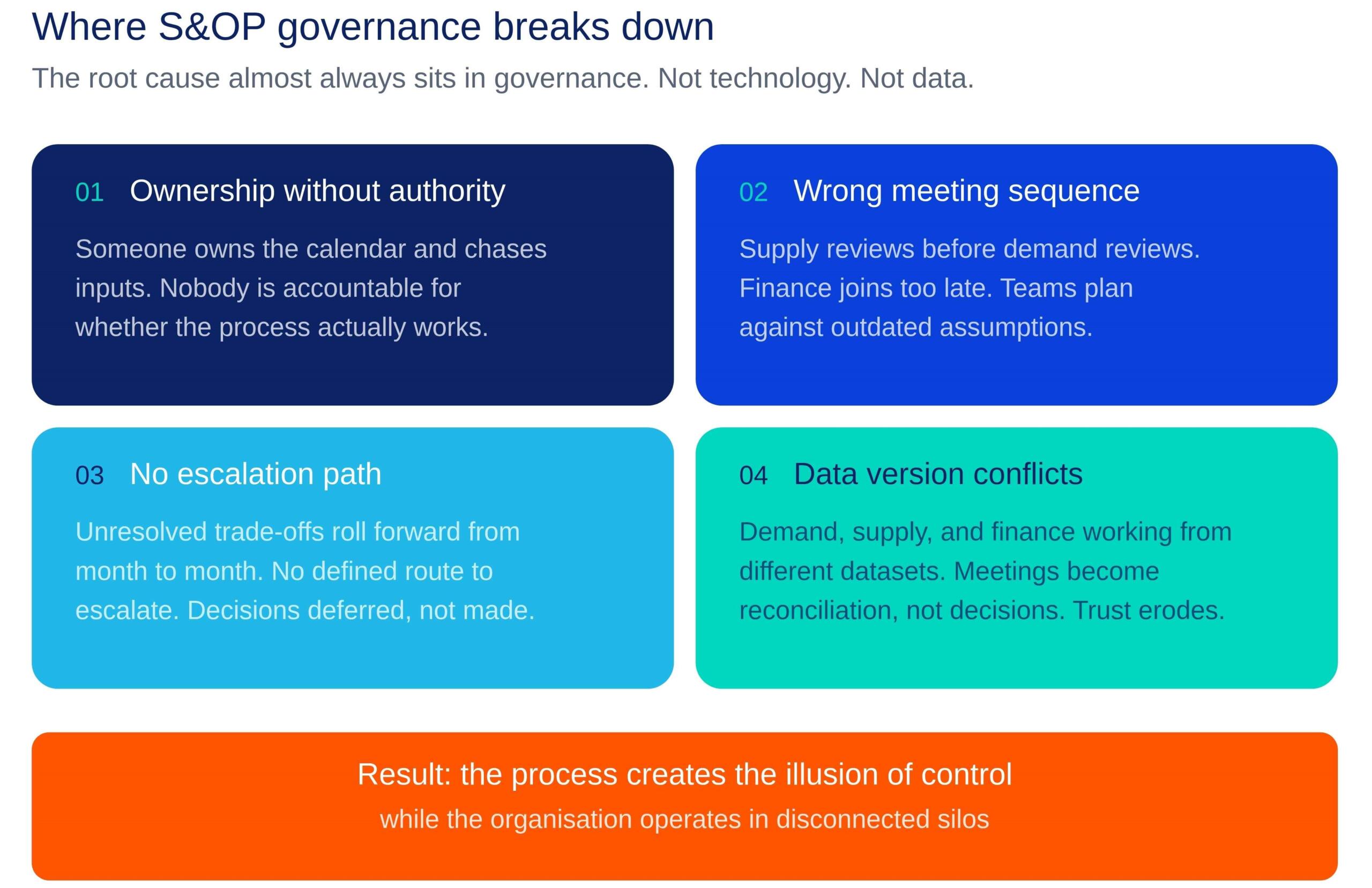
When we dig into why an S&OP process has stalled, the root cause almost always sits in governance. Not technology. Not data. Governance.
Ownership without authority
Someone owns the S&OP calendar. They chase inputs, compile packs, and facilitate meetings, but they don’t have the authority to hold senior leaders accountable for preparation, attendance, or follow-through. The process runs, but nobody is responsible for its effectiveness.
The wrong meeting sequence
It sounds mechanical, but meeting cadence matters enormously. When the supply review happens before the demand review, supply teams are planning against outdated assumptions. When finance joins only at the executive review, the financial implications of operational trade-offs surface too late to influence decisions.
No formal escalation path
In mature organisations, S&OP has a clear mechanism for surfacing decisions that can’t be resolved at working level. In stalled programmes, unresolved trade-offs simply roll forward from month to month. Nobody escalates, because there’s no defined route to do so. Decisions get deferred rather than made.
Version control and data trust
When demand, supply, and finance are working from different versions of the same data – or worse, from entirely different datasets – meetings become debates about whose numbers are right. The time that should go to decision-making goes to reconciliation instead. Trust erodes, and people start building their own shadow models.
The organisational barriers that keep S&OP stuck
Governance failures don’t happen in a vacuum. They’re symptoms of deeper structural issues.
Culture is the most common. In organisations where departments have historically operated independently, S&OP asks people to do something uncomfortable: share information, surface problems early, and accept trade-offs that may not favour their function. That’s a cultural shift, not a process change. And without sustained leadership commitment, the old habits reassert themselves.
Conflicting incentives are another barrier. If sales is measured on revenue, operations on cost, and finance on margin, each function is optimising for a different outcome. S&OP is supposed to mediate these tensions. But when the process lacks authority, the incentive conflicts win. Sales inflates the forecast to secure supply. Operations cuts inventory to hit working capital targets. Procurement buys in bulk for cost savings without reference to actual demand. Each decision makes sense in isolation. Together, they generate excess stock, service failures, and margin erosion.
Then there’s the technology gap. Many organisations are still running S&OP on spreadsheets, with planners spending days compiling data from multiple systems before each cycle. By the time the numbers are ready, they’re already stale. The process is too slow to surface risk in time to act on it, and too rigid to adapt when conditions change between cycles.
The hidden financial cost of S&OP failure
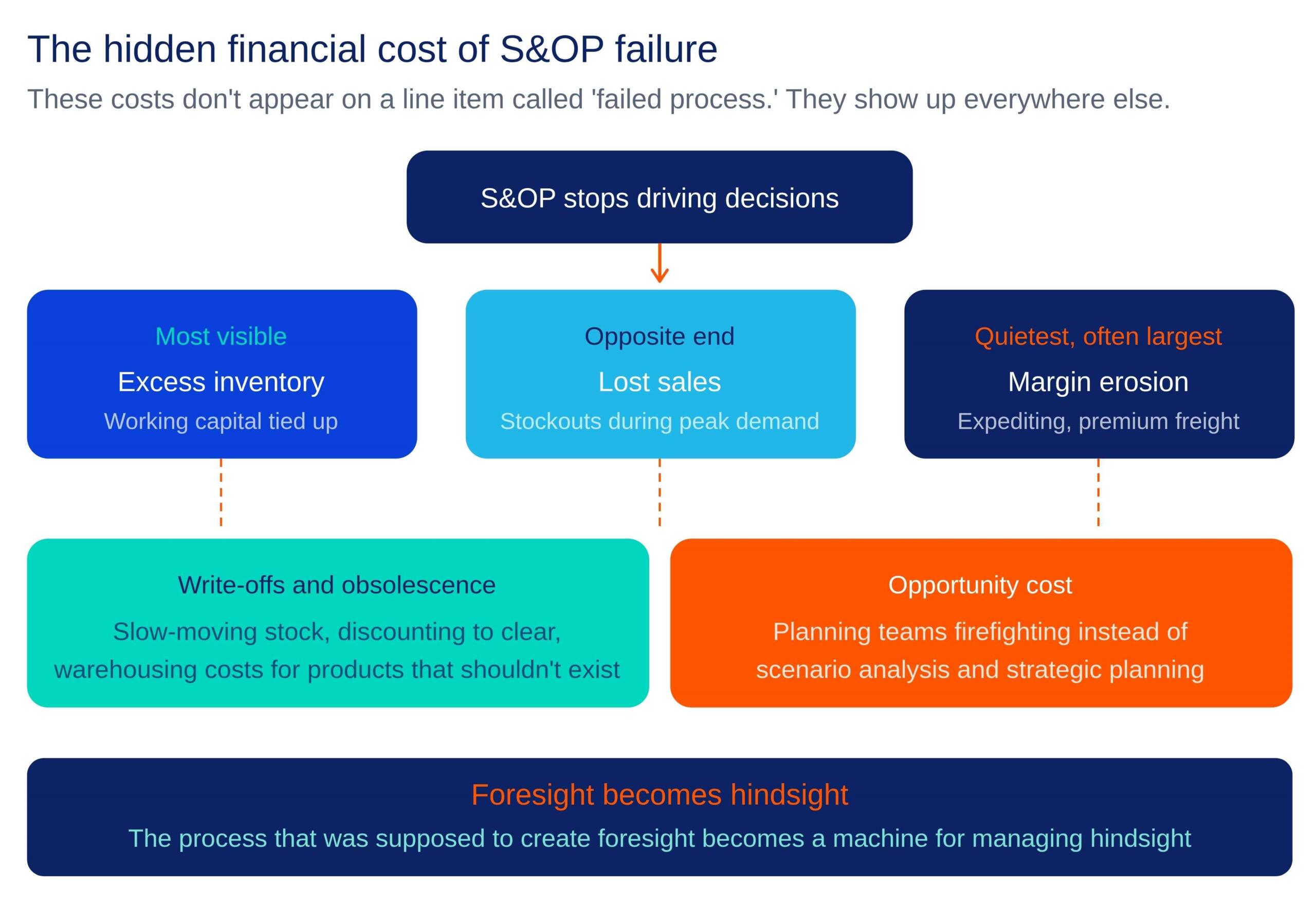
When S&OP stops working, the costs don’t appear on a line item called ‘failed process.’ They show up everywhere else.
Excess inventory is the most visible. Poor demand alignment and inflated safety stocks tie up working capital that could be deployed elsewhere. But the downstream costs are often worse: write-offs for obsolete stock, discounting to clear slow-moving lines, warehousing costs for products that shouldn’t have been built in the first place.
Lost sales sit at the other end. When supply constraints aren’t integrated into demand decisions, stockouts happen during peak demand periods. Revenue leaks out of the business, and customer relationships take the hit.
Margin erosion is the quietest cost, and often the largest. When plans change at the last minute, expediting becomes the norm. Premium freight, emergency sourcing, overtime production – these are all symptoms of a planning process that can’t see far enough ahead. Each one chips away at the margin the business thought it was going to make.
And then there’s the opportunity cost. When your planning team is spending its time firefighting and reconciling data, it’s not spending time on scenario analysis, risk assessment, or strategic planning. The process that was supposed to create foresight becomes a machine for managing hindsight.
When your planning team spends its time firefighting and reconciling data, the process that was supposed to create foresight becomes a machine for managing hindsight.
How to tell if your S&OP process has stalled
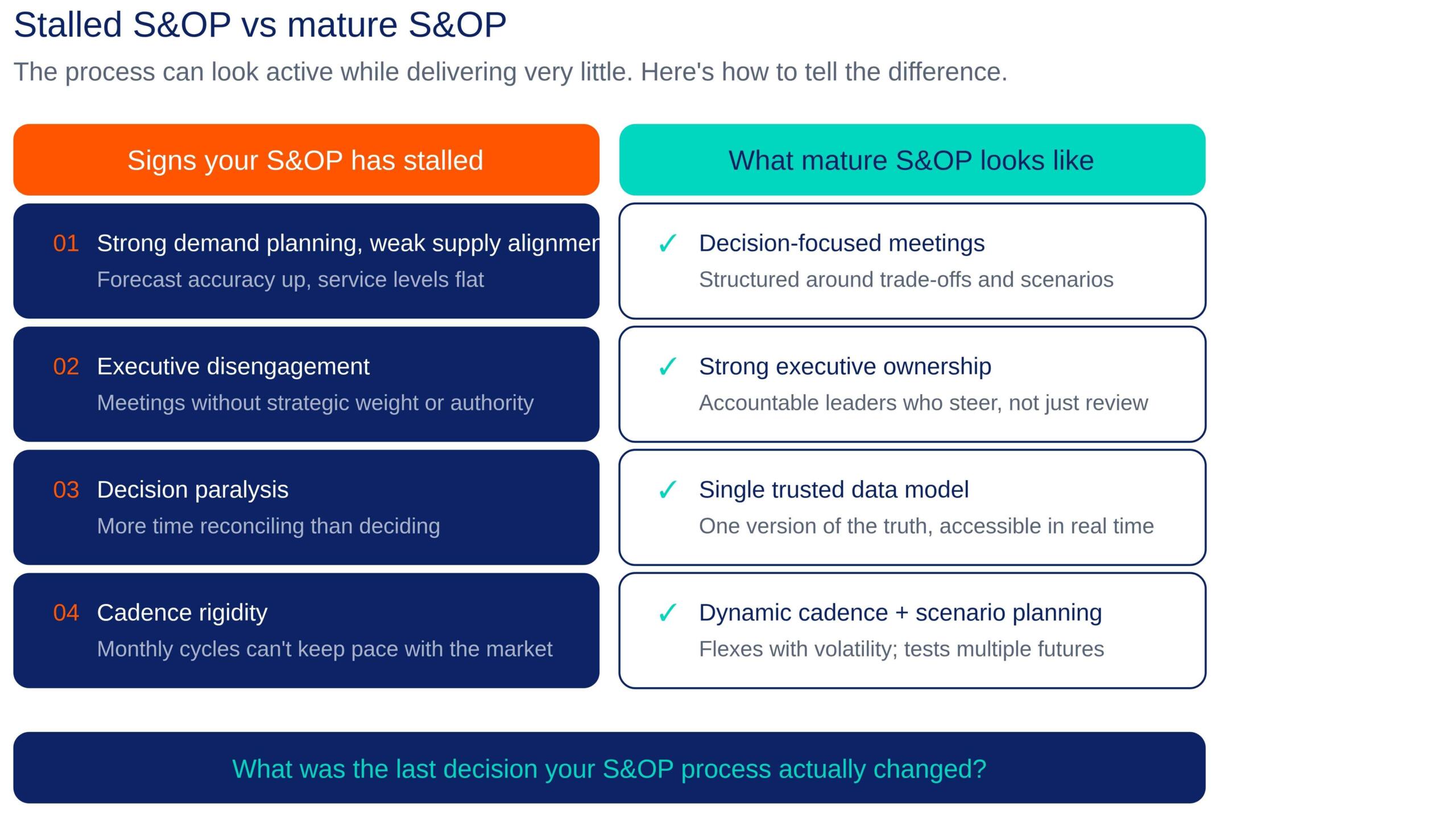
The tricky thing about S&OP stalling is that the process can look active while delivering very little. Here are the patterns we see most frequently.
The first is strong demand planning but weak supply alignment. Forecast accuracy has improved, but service levels haven’t followed. Supply constraints aren’t being fed into the demand conversation, so the plan looks good on paper but breaks down in execution.
The second is executive disengagement. Senior leaders attended at the start, but their participation has dropped away. Meetings have become operational reviews without strategic weight. The process has lost its authority.
The third is decision paralysis. Multiple versions of demand and inventory data exist across the business. Teams spend more time arguing about baseline assumptions than discussing trade-offs. Nobody trusts the numbers enough to act on them.
The fourth is cadence rigidity. The monthly cycle can’t keep pace with the speed at which conditions are changing. By the time a risk is discussed in the S&OP meeting, the window to respond has already closed. The process feels slow and irrelevant.
If any of these sound familiar, the issue isn’t that your S&OP was poorly designed. It’s that it hasn’t been sustained, governed, or equipped to operate in the environment you’re now working in.
What a mature S&OP environment actually looks like
The organisations that get S&OP right don’t just run a process. They treat it as the operating rhythm of the business.
That means decision-focused meetings, not data-focused ones. The preparation happens before the room. The meeting itself is structured around the three or four key decisions that need to be made, the trade-offs involved, and the scenarios that have been modelled to inform them.
It means strong executive ownership. Not attendance for its own sake, but active participation from leaders who are accountable for outcomes, who challenge assumptions, and who use the process to steer the business – not just review it.
It means a single, trusted data model. One version of the truth across demand, supply, and finance, accessible in real time, so that conversations start from a shared understanding rather than a reconciliation exercise.
It means scenario-driven planning. Regular use of what-if analysis to evaluate risks and opportunities before they materialise. Not just the most likely outcome, but the plausible disruptions that could reshape the picture.
It means dynamic cadence. The ability to move from monthly to weekly – or even continuous – planning when volatility demands it. And the ability to step back to monthly when conditions stabilise.
And it means clear governance: defined decision rights, formal escalation paths, and KPIs that are tied to business outcomes like margin, working capital, and service – not just process compliance.
This isn’t aspirational. We see it working in the organisations we support. When S&OP is properly governed, connected to the right data, and backed by tools that enable scenario modelling and real-time visibility, it becomes the most powerful planning mechanism a business has. When it’s not, it becomes one of the most expensive.
The question to take back to your leadership team
We’d encourage you to bring one question to your next S&OP meeting: what was the last decision this process actually changed?
Not the last report it produced, not the last forecast it reviewed, but the last time this process surfaced a risk, a trade-off, or an opportunity that led to a different course of action.
If you can’t answer that clearly, your S&OP isn’t failing loudly. It’s failing quietly. And quiet failure is the most expensive kind.
What to read and do next
Read previous: The early warning signals your supply chain is already showing you
Go deeper: Our insight paper, The avoidable cost of disconnected supply chain planning: A Bedford perspective on where supply chain risk really builds, and how to see it earlier, brings together early warning signals, S&OP blind spots, and the connected planning model in a single gated download.
If the picture in this piece is recognisable, we would value the exchange as much as you might. You can reach us at info@bedfordconsulting.com, or follow Bedford Consulting on LinkedIn for the next piece in this series on connected planning in automotive and industrial manufacturing.