Can you explain your AI forecast to the CFO?
Share
Related Posts


Two forecasts nobody trusts
Most finance teams know the first one well. It takes weeks of spreadsheet loops to build, and by the time it’s approved, it’s already out of date. The second one is newer. It’s the AI forecast that arrives in minutes, looks impressive, and then stalls in the first review meeting because nobody can explain how it got there.
Gartner describes the shift well. As AI-enabled forecasting scales, the risk moves upstream: away from visible errors in the output and into the assumptions and inputs that shape it. The usual sign-off no longer tells you what it used to. As Gartner puts it, “approval loses value as a signal of understanding.”
The first is too slow to be useful. The second is too opaque to be used. In our last post we asked whether you’d trust an AI agent to build your model. This time the question is simpler, and it matters more to the CFO: would you trust the number it gives you?
Where AI genuinely helps forecasting today
In Anaplan, machine forecasting runs through PlanIQ. It uses the history, related data and attributes already in your model, tests several statistical and machine-learning methods, and shows how accurate each one has been. Used well, it helps in four places:
- A faster baseline. A statistical forecast in minutes, so the team starts from a number instead of a blank sheet.
- Finding the drivers. It shows which inputs matter most to a forecast, which often confirms what planners suspect and sometimes surprises them.
- Spotting anomalies. Lines that don’t behave like their history get flagged early, before they reach the board pack.
- Quicker scenarios. Re-run the forecast when an assumption changes, rather than rebuilding the spreadsheet.
The realistic expectation: AI gives you a better starting point and more time for judgement. It doesn’t give you a finished forecast.
Machine forecast vs driver-based plan: partners, not rivals
The mistake is to treat these as a choice. They answer different questions, and the value comes from putting them side by side.
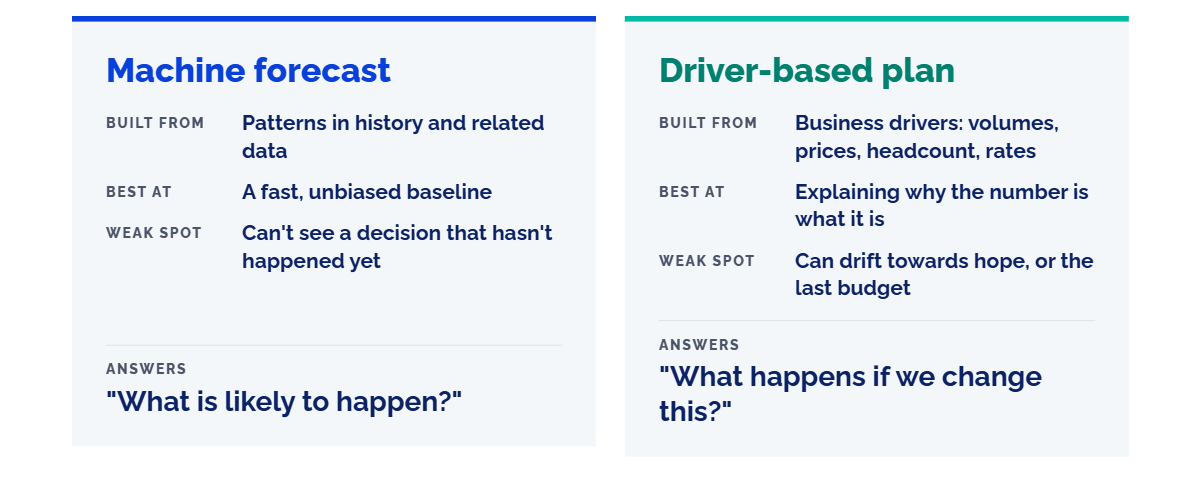
When the two agree, you can move faster with more confidence. When they disagree, you’ve found the conversation worth having. Either the drivers are missing something the data can see, or the business knows something the history can’t.
What makes a forecast defensible
A CFO or auditor doesn’t need to understand the algorithm. They need to know that someone does, and that the number can be traced. In practice that comes down to five things:
That’s also where Gartner suggests CFOs focus their oversight: on system design, driver selection and governance, not just the final number.
- A named owner. Every forecast line has a person who signs it off, whether a machine produced the first draft or not.
- Explained drivers. You can say which inputs moved the number, in business terms rather than statistical ones.
- Measured accuracy. You track how each method has performed against actuals over time, so trust is earned, not assumed.
- Overrides with a reason. When someone changes the machine’s number, the reason and the name are recorded.
- A clear version trail. You can show what the forecast was, what changed and why.
If these sound familiar, they should. They’re the five foundations from our first post, applied to a single number. Trusted data, clear structure, business context, review and people are what make an AI forecast usable.
Where AI forecasting still falls short
Being honest about the limits is what makes the rest credible. Machine forecasting struggles when:
- History is thin. A new product, market or cost centre gives the model little to learn from.
- The future breaks from the past. A price change, an acquisition or a one-off event won’t be in the data until after it happens.
- The data isn’t trusted. If actuals are restated every month or definitions differ between teams, the model learns the mess.
- Nobody owns the output. A forecast that no one is accountable for won’t be used, however accurate it is.
In each case, the fix isn’t a better algorithm. Research from Vlerick Business School, based on a survey of more than 100 senior finance executives, reached the same conclusion: “the real obstacle turns out to be not the technology itself”, but whether the finance organisation is ready to absorb and apply it. That means better data, clearer drivers and a person who owns the number.
Our view: faster numbers you can still defend
So, can you explain your AI forecast to your CFO? Yes, if it sits alongside your driver-based plan, has a named owner and is measured against actuals.
AI makes the forecast faster. Drivers make it explainable. People make it defensible. Take any one of those away and you’re back to either the slow forecast or the opaque one.
That’s why finance shouldn’t just use AI forecasting; it should help shape it. As Harvard Business Review argues, the companies that succeed with AI aren’t necessarily the ones with the most advanced models. They’re the ones where finance helps judge the value, keeps people accountable and brings an objective view.
Frequently asked questions
What to read and do next
Previous article
Would you trust an AI agent to build your next Anaplan model?
Want the honest version, live? On 24 November, Horváth and Bedford Consulting will show where AI genuinely helps planning today, what agentic AI means for finance teams, and what needs to be in place before you switch the agents on. 45 minutes, free, with a live look in Anaplan. Save your seat →
If this feels recognisable, we would value the conversation. Reach us at info@bedfordconsulting.com or follow Bedford Consulting on LinkedIn.