Connected planning is how you protect margin in a volatile market

Share
Related Posts


Short on time? Watch the video to hear why even high-performing teams can lose margin when planning is disconnected.
Then dive into the article below to learn how connected planning helps CPG organisations improve visibility, align decisions and respond faster to change.
Reading the Shelf | CPG and Retail Organisations
In CPG, margin can be lost quietly long before it appears in the numbers. Demand shifts, retailer requirements change, promotions move, stock builds in the wrong places and teams are forced to make fast decisions with incomplete visibility. Sales, supply chain, finance, category and operations may all be working hard, but if the plan is not connected, the business can still lose value.
That value often shows up in the places CPG leaders care about most: excess inventory, retailer service level pressure, promotional inefficiency, end-of-season discounting, missed sales opportunities and margin erosion. When teams are disconnected, even strong functional performance can still create avoidable commercial impact.
Connected planning is not just about having better tools. It is about giving CPG teams one shared way to make better decisions across demand, supply, inventory, promotions and finance.
CPG planning problems rarely sit in one team
Most CPG planning challenges do not happen because one team has failed. They happen because teams are making decisions from different versions of the truth.
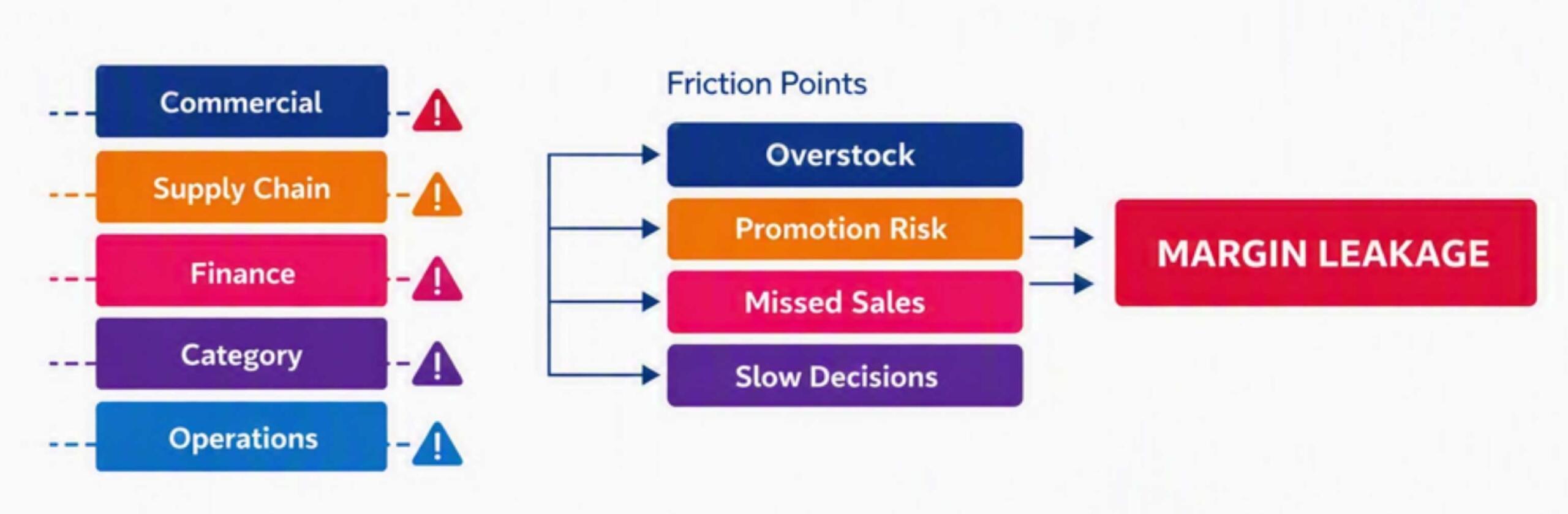
Commercial teams may be looking at retailer demand and promotional plans. Supply chain may be looking at availability and production constraints. Finance may be looking at margin and trade spend. Category teams may be looking at range performance and shopper trends. Each view matters, but when those views are not connected, the business is forced to make decisions in fragments.
That is when businesses start to see familiar planning symptoms:
- Too much stock in the wrong SKUs, channels or locations.
- Discounting used to clear avoidable overstock after a promotion or season has passed.
- Lost sales because availability does not match retailer demand.
- Slow decisions because teams are debating which forecast to trust.
- Margin pressure caused by trade-offs being made too late.
The issue is not always effort. Often, it is alignment. Without connected planning, CPG teams can optimise locally while the wider business still loses margin, service and agility.
Why connected planning matters for CPG margin
Margin in CPG is not protected by one decision at the end of a quarter or season. It is protected through hundreds of connected decisions across forecasting, promotions, production, inventory, replenishment and commercial planning.
When demand, supply, inventory, finance and commercial planning are connected, CPG organisations can respond earlier. They can see when demand is changing, understand the stock implications, assess the margin impact and adjust before the cost becomes unavoidable.
That means better availability for retailers, fewer reactive discounts, less excess stock, stronger promotional control and better protection of margin. The value is not just in building a model. The value is in helping teams make faster, better commercial decisions from it.

A planning platform is only the start
Many organisations think the project is complete when the planning tool goes live. In reality, that is often where the most important work begins.
A tool can connect data, automate workflows and surface insights, but the business still needs to adopt it, trust it and improve it over time. CPG planning is never static. Consumer behaviour shifts, retailer priorities change, promotions move, supply constraints appear and new channels create new planning demands. A planning solution needs to evolve with that reality.
That is why connected planning should never be treated as a one-off implementation. It should be treated as a long-term planning journey.
From building the tool to improving the way you plan
That means building the right foundations first, supporting adoption across commercial, finance, supply chain and category teams, and then helping organisations expand connected planning into other use cases where it can create value. The objective is not just implementation. It is better planning maturity over time.
That means building the right foundations first, supporting adoption across the business, and then helping teams expand connected planning into other areas where it can create value. The objective is not just implementation. It is better planning maturity over time.
Because the end goal is not a system that technically works. It is a business that can see more clearly, respond faster and make decisions that protect value.

Our view
For CPG organisations, disconnected planning creates hidden cost. It slows decisions, weakens alignment and makes it harder for teams to protect margin, service and stock performance, even when everyone is doing their job well.
The strongest CPG planning organisations do not just connect data. They connect decisions. They create a planning environment where teams can understand the impact of their choices across the whole business, from customer demand and trade promotions through to inventory, supply and margin.
That is where connected planning becomes more than a technology project. It becomes a way to protect margin, improve agility and create a planning process that keeps getting better.
What to read and do next
First in the series
Most CPG businesses don’t have a visibility problem, they have a planning problem
Next in the series
Better planning starts with people, process, then technology
Stop reacting. Start anticipating. Join CPG leaders at Demand Planning Maturity Gap for CPG on 4th November to benchmark your demand planning maturity and learn what it takes to reach the next level. Register now →
Ask yourself three questions
Before your next CPG planning review, consider:
- Where are commercial, supply chain, category and finance teams still working from different versions of the truth?
- Where is disconnected planning creating stock, service, promotion or margin risk?
- What planning decisions could be improved if teams had a more connected view of demand, inventory and financial impact?
Where Bedford helps
Successful CPG planning transformation requires more than technical delivery. It requires the right use cases, the right process design, strong adoption across functions and a long-term view of how planning maturity should evolve.
At Bedford, we help CPG organisations build connected planning capabilities that do more than go live. We help teams create planning processes that are adopted, improved and expanded over time, so they can make better decisions across demand, supply, promotions, inventory and margin. Get in touch today to find out how we can help.. Get in touch