Would you trust an AI agent to build your next Anaplan model?
Share
Related Posts



The question everyone in Anaplan is asking
Finance has always run on trust. A forecast, a board pack or a deal model is only useful if people believe it. AI is testing that trust in a new way.
On a recent episode of Financial Modeler’s Corner, Ryan Humphrey, a Partner at Forvis Mazars who audits financial models, put the risk simply: “Trust becomes so important because things can look right very quickly, even when they are not.”
He was talking about Excel models, but the business challenge is the same in any planning platform. As AI makes building cheaper, reviewing becomes the work that matters. And, as he puts it, “what cannot be replaced is judgement.”
Anaplan is a good place to see this play out. Its AI can now turn a plain-language request into a build plan for lists, modules and calculations. So the question for finance teams is no longer whether AI can build a planning model. It’s whether you’d trust what it builds.
What AI agents can already do
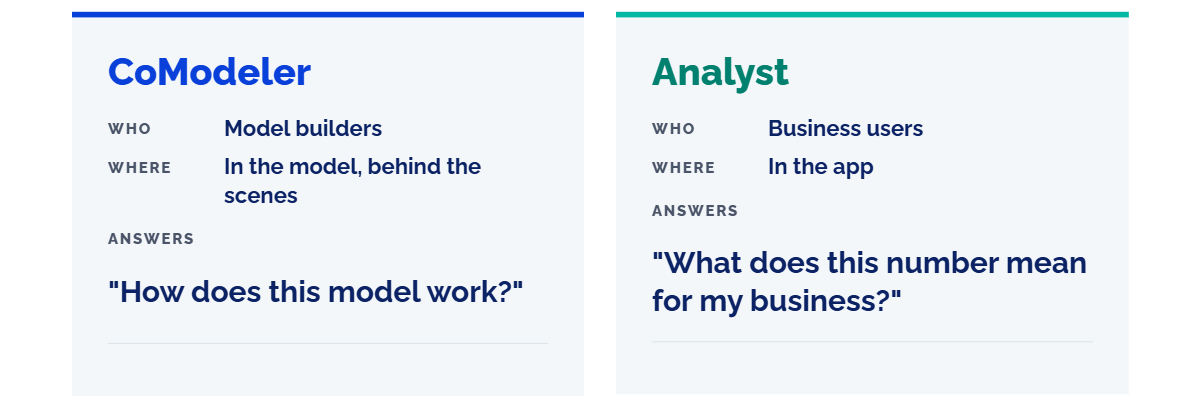
CoModeler is the one that builds. It turns a plain-language request into a step-by-step build plan of modules, lists and calculations, extends existing models, and reviews models for inefficiencies, error-prone formulas and redundant structures. It also writes plain-language documentation. Importantly, it never makes changes automatically: every build plan is presented for review and approval.
Analyst is the one that explains. Business users ask planning questions in everyday language, and it explains what changed and surfaces the drivers that matter. It shows the exact source data behind each answer and respects your existing Anaplan roles and data access controls.
Used well, that changes the shape of the work:
- Faster first drafts. Test a modelling concept in hours rather than waiting for the next build sprint.
- Best practice by default. Consistent naming, structure and formula patterns from the first module.
- Business language, not just syntax. Technical logic explained in terms a planner or controller can check.
What it doesn’t change is who is accountable for the number that reaches the board.
Five foundations that make AI worth trusting
In our experience, the biggest risk is never the maths. It’s whether people trust and act on the output. An agent makes that risk bigger, not smaller, because it moves faster than your review process.
Filip Czerniawski, Consultant and Master Anaplanner at Bedford, puts it simply: “More output is easy. Less rework is more valuable.” He works from five foundations. None of them is new, and all of them matter more once AI is involved:
-
Trusted data. Reliable data and agreed definitions. If your organisation can’t answer “what does this measure mean?”, an AI can’t either.
- Clear structure. Lists and modules with a clear purpose, understandable to everyone and not just the person who built them. Ask CoModeler about your chart of accounts when the model has five of them, and you’ll see why.
- Business context. A formula tells you what a calculation does. It doesn’t tell you why it exists, or why one cost centre is treated as an exception.
- Access and review. Who can see which answers, and who checks them. Analyst respects your existing Anaplan roles and access controls, so a clear role design matters more than ever.
- People. Expertise, collaboration and accountability. Someone has to decide whether a suggestion is useful and right for the business.
“We don’t need a perfect model before we start using AI. But we need to know where the weaknesses are.” Filip Czerniawski, Bedford Consulting
AI accelerates whatever it’s built on. On weak foundations, it accelerates the wrong decisions.
In practice: a model that took 10 minutes to roll back
A customer asked us to look at a slow model. Every rollback took more than 10 minutes.
- We asked CoModeler to flag the worst-performing formulas. It pointed to a complex IF statement held as a number rather than a Boolean.
- Then we checked what depended on it. The line item was referenced in many places, including as a DCA, which is hard to trace by hand. CoModeler found the connections quickly.
- People made the fix. We switched to a Boolean, simplified the formulas that referenced it and trimmed items from several lists.
The result was a smaller model and more room in the workspace. The AI found the problem faster. The judgement on how to fix it stayed with the team.
Five questions to ask before an agent touches your model
- Would you trust the data it’s building on? If the answer is “mostly”, start there.
- Who owns each list, driver and assumption? Name them before the agent starts, not after.
- What may the agent change, and what may it only suggest? Write the guardrails down.
- How will you review what it built? Structure, formulas, performance and outputs, every time, by someone who understands the business.
- How will you measure it? Time saved, errors caught and overrides needed, so you know whether it’s helping.
If you can answer all five, you’re ready to let an agent help. If you can’t, that’s where the real work is.
Our view: agents accelerate, people stay accountable
So, would we trust an AI agent to build your next Anaplan module? Yes, once the foundations are in place and a person still owns the result.
The tools already point that way. CoModeler asks you to approve every suggestion, and once you do, the change appears in the model’s history under your name. The agent proposes; a person decides and owns it.
Anaplan brings the AI. Bedford makes sure the business can rely on what it decides. We’re proud to be one of 12 preferred AI partners for CoModeler and Agent Studio, named in June 2026. But our first question is never “which agent?” but “is your planning ready for it?”
Frequently asked questions
What to read and do next
Want the honest version, live? On 24 November, Horváth and Bedford Consulting will show where AI genuinely helps planning today, what agentic AI means for finance teams, and what needs to be in place before you switch the agents on. 45 minutes, free, with a live look in Anaplan. Save your seat →
If this feels recognisable, we would value the conversation. Reach us at info@bedfordconsulting.com or follow Bedford Consulting on LinkedIn.